
Some acts of faith are dramatic. Abraham leaving his homeland was dramatic. Noah building an ark before the rain was dramatic. Abraham placing Isaac on the altar was almost unthinkable.
But not every expression of faith looks like a crisis.
Sometimes faith is quieter. Sometimes faith looks like an old man, near the end of his life, placing his hands upon his children and speaking words about a future he will never see.
That is Isaac’s moment in Hebrews 11:
“By faith Isaac blessed Jacob and Esau concerning things to come” (Hebrews 11:20, NKJV).
Isaac’s faith was looking forward. He was blessing a future that belonged to another generation. And that gives us a beautiful picture of faith:
Faith trusts God with a future it may never live to see.
Faith looks beyond the present
Hebrews does something interesting with Isaac. It does not mention the well disputes of Genesis 26. It does not mention his wealth. It does not focus on his marriage to Rebekah.
Instead, Hebrews remembers one particular act, that “by faith Isaac blessed Jacob and Esau concerning things to come.”
The phrase “things to come” is important.
Isaac was thinking beyond the present. Faith always has a forward-looking dimension. The world around us constantly encourages us to live for what we can see, touch, possess, and experience now.
Esau’s life became a warning of what happens when the present becomes more important than the future. Hebrews later describes him as one who, for one meal, sold his birthright (Hebrews 12:16).
But faith looks further.
Faith says that what God has promised is more valuable than what the world can offer today. Isaac’s blessing belonged to the future. The promise had not yet reached its fulfilment. The covenant people had not yet become the multitude God had promised Abraham. The promised Seed had not yet come. The nations had not yet been blessed through Christ. Yet Isaac believed that God’s purposes were moving forward. He blessed according to that future.
Let’s peer into Isaac’s complicated family situation.
A complicated family
The story in Genesis 27 is not simple.
Isaac was old. His eyes were dim. He believed he was approaching death. And he intended to bless Esau, his elder son, according to Hebrew blessings betokened to the firstborns.
But there was a problem.
Before the twins were born, God had told Rebekah something significant:
“Two nations are in your womb,
Two peoples shall be separated from your body;
One people shall be stronger than the other,
And the older shall serve the younger” (Genesis 25:23, NKJV).
Isaac’s preference for Esau complicated matters.
Esau was his favourite because Isaac loved the taste of the game he brought home (Genesis 25:28). Rebekah, meanwhile, favoured Jacob.
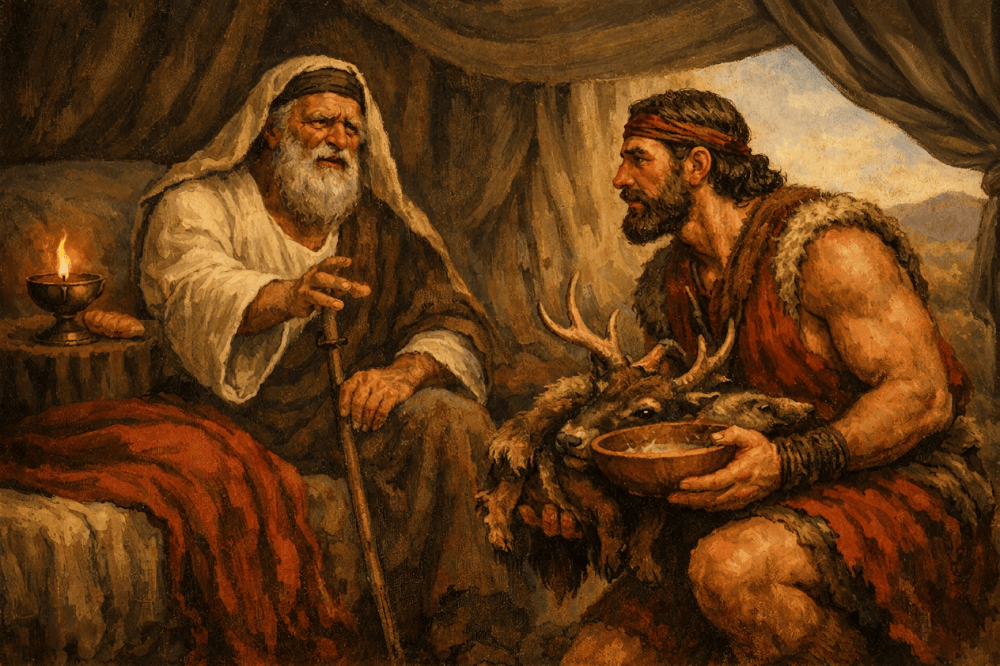
Then came deception.
Rebekah and Jacob devised a plan to obtain Isaac’s blessing for Jacob. Jacob disguised himself as Esau. Isaac was deceived. And Jacob received the blessing.
It would be easy to read the story and conclude that Isaac’s faith was flawless. It was not. The Bible does not hide the weaknesses of its heroes. Isaac’s intentions concerning Esau were out of step with God’s revealed purpose.
Rebekah and Jacob’s response was also wrong. They did not need deception. God had already spoken.
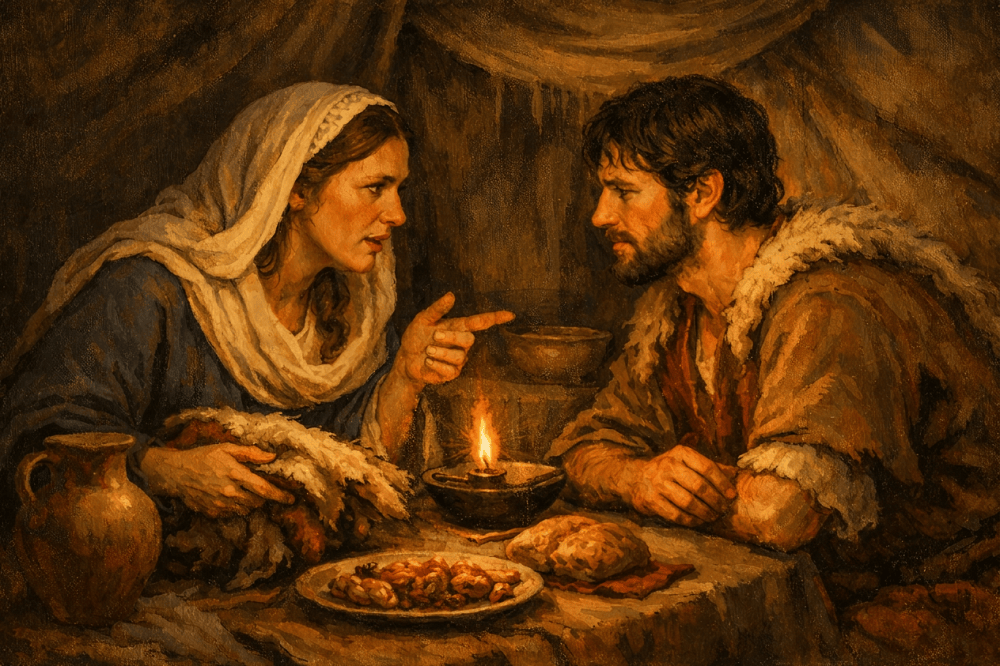
As Ellen White observes in Patriarchs and Prophets, God had declared that Jacob would receive the birthright, and His word would have been fulfilled in His own time had they waited in faith for Him to work:
“Jacob and Rebekah succeeded in their purpose, but they gained only trouble and sorrow by their deception. God had declared that Jacob should receive the birthright, and His word would have been fulfilled in His own time had they waited in faith for Him to work for them. But like many who now profess to be children of God, they were unwilling to leave the matter in His hands. Rebekah bitterly repented the wrong counsel she had given her son; it was the means of separating him from her, and she never saw his face again.”
–Ellen G. White, Patriarchs and Prophets, p. 180
That is an important lesson.
Faith never needs manipulation to accomplish God's promise.
But something remarkable happens after Isaac discovers what has taken place. He does not attempt to reverse the blessing.
Instead, he says:
“...I have blessed him—and indeed he shall be blessed” (Genesis 27:33, NKJV).
Something has changed. Isaac recognises that God’s purpose has prevailed. And Hebrews looks back upon this moment and says, “By faith Isaac blessed Jacob and Esau concerning things to come.”
God’s providence had overruled human weakness.
Faith learns to trust God’s future
Isaac’s story reminds us that faith is not the same as perfection.
Faithful people can still make mistakes. They can misunderstand. They can allow personal preferences to influence their decisions. They can sometimes try to help God accomplish what He has already promised.
Yet God is faithful.
The power of the story is not that Isaac controlled the future perfectly. He did not. The power is that, ultimately, Isaac trusted God’s purpose. When he realised that Jacob was the one whom God had chosen, he did not try to fight God’s decision. He accepted it. Then he blessed Jacob.
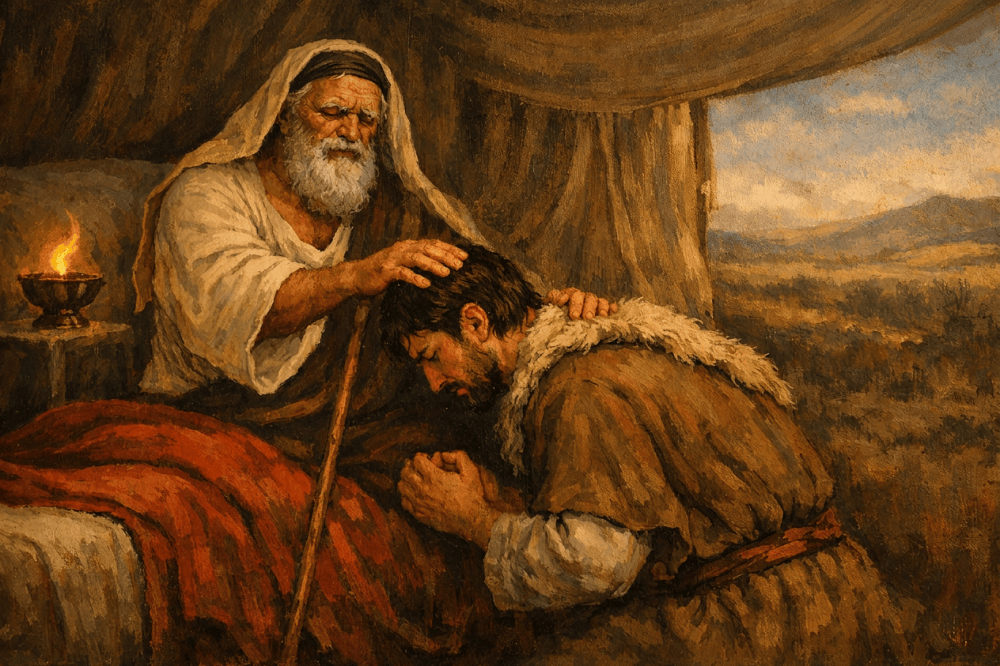
Later, when Jacob was preparing to leave for Mesopotamia, Isaac deliberately renewed the covenant blessing:
“May God Almighty bless you,
And make you fruitful and multiply you,
That you may be an assembly of peoples;
And give you the blessing of Abraham,
To you and your descendants with you,
That you may inherit the land
In which you are a stranger,
Which God gave to Abraham” (Genesis 28:3-4, NKV).
Now the blessing was intentional.
Isaac was no longer simply blessing the son he had thought was Esau. He was consciously passing the covenant promise forward. Faith had learned to trust the future God had chosen.
What are we passing on?
This is where Isaac’s story becomes deeply personal.
Most of us will not build an ark. Most of us will not leave our homeland because God calls us somewhere unknown. Most of us will not stand on Mount Moriah. But every generation faces one question:
What will we pass on to the generation that follows us?
We pass on more than possessions:
- We pass on values
- We pass on convictions
- We pass on habits
- We pass on stories
- We pass on our understanding of God
- We pass on the way we respond when life becomes difficult
Children and young people often learn about faith not simply from what we teach them, but from what they see us trust:
- They watch how we speak when prayers seem unanswered
- They watch how we treat people who disagree with us
- They watch what we do when money is tight
- They watch whether Sabbath is a burden or a delight
- They watch whether worship is merely a weekly routine or the centre of our lives
- They watch whether we forgive
- They watch whether we serve
- They watch whether Jesus is genuinely precious to us
Faith is transmitted through testimony. Sometimes the greatest sermon we will ever preach is the life we leave behind.
Blessing beyond sight
Isaac blessed concerning “things to come.”
He could not see the complete fulfilment of the covenant. He could not see Jacob’s twelve sons. He could not see Israel become a nation. He could not see Bethlehem. He could not see Calvary. He could not see the empty tomb. He could not see the gospel reaching the nations.
Yet he blessed the future anyway.
This is one of the quiet powers of faith. Faith does not require us to see the whole story before we trust the Author.
The same principle applies to us. You may be raising children whose future you cannot predict. You may be mentoring a young person whose potential you can see but whose final story you cannot know. You may be teaching a Bible class and wondering whether anyone is truly listening. You may be serving in a ministry whose results you will never see. You may be planting seeds in your family that another generation will harvest.
Do not underestimate what God can do with faithful seeds.
Paul reminded the Corinthians:
“I planted, Apollos watered, but God gave the increase” (1 Corinthians 3:6, NKJV).
Our responsibility is faithfulness. God is responsible for the harvest.
The blessing points to Christ
There is an even greater future hidden within Isaac’s blessing.
God had promised Abraham:
“In your seed all the nations of the earth shall be blessed, because you have obeyed My voice” (Genesis 22:18, NKJV).
That promise continued through Isaac. It continued through Jacob (later named Israel). It continued through the children of Israel. But ultimately, the blessing reaches the world through Jesus Christ.
Paul explains:
“Now to Abraham and his Seed were the promises made. He does not say, “And to seeds,” as of many, but as of one, “And to your Seed,” who is Christ” (Galatians 3:16, NKJV).
Isaac was part of the chain of promise. Jacob would continue it. Israel would carry it. But Christ is the promised Seed. And through Christ, the blessing reaches beyond one family, one nation, and one generation.
The promise becomes global. The gospel becomes universal. The blessing becomes ours.
Paul writes:
“And if you are Christ’s, then you are Abraham’s seed, and heirs according to the promise”(Galatians 3:29, NKJV).
Isaac’s blessing was looking forward to something much greater than Jacob. It was moving towards Christ.
From the Conflict of the Ages Series
Reflecting on the moment when Isaac realised that Jacob had received the blessing, Ellen G. White writes:
“While the words of blessing were upon his lips, he had felt the Spirit of inspiration upon him; and now, knowing all the circumstances, he ratified the benediction unwittingly pronounced upon Jacob: ‘I have blessed him; yea, and he shall be blessed.’”
— Ellen G. White, Patriarchs and Prophets, p. 181.
The important point is not that Isaac’s earlier decisions were beyond correction. They were not. Rather, God was able to work through human weakness without surrendering His purpose. Isaac eventually recognised what God was doing.
And when he did, he submitted to God’s purpose rather than clinging to his own preference.
That, too, is faith.
Looking unto Jesus
Isaac’s story ultimately teaches us where every promise is heading. Jesus is the One through whom the blessing reaches us.
He is the Seed of Abraham. He is the fulfilment of God’s covenant promises. He is the One in whom every generation can find hope. And there is something deeply encouraging about that.
We do not have to see the whole future to have confidence in it.
Why?
Because our future is held by Christ. Jesus told His disciples:
“...I go to prepare a place for you”(John 14:2, NKJV).
We have not seen that place. We have not walked its streets. We have not experienced its glory. But we trust the One who promised it.
And Scripture gives us this assurance:
“Let us hold fast the confession of our hope without wavering, for He who promised is faithful” (Hebrews 10:23, NKJV).
That is the foundation of faith. Not our ability to predict tomorrow. Not our ability to control our children. Not our ability to guarantee the success of our ministry. Not our ability to see the final outcome.
God is faithful.
So we can bless, teach, serve, pray, give, mentor, and live faithfully—even when the results belong to another generation.
Living by faith today
Ask yourself, “What am I passing on?”
What will my children remember about my relationship with God? What will those I mentor learn from my life? What kind of faith will my family inherit from me? Perhaps today you need to stop trying to control the future.
You cannot.
But you can place it in God’s hands. You can pray for the next generation. You can teach them Scripture. You can tell them what God has done. You can model repentance when you fail. You can show them what forgiveness looks like. You can bless them with words of hope. And you can trust God with the results.
Your faithfulness today may become someone else’s foundation tomorrow. You may never know the full extent of what God does through it. But faith does not demand to see the harvest.
Faith is willing to plant.
Faith focus
Faith trusts God's future even when we cannot see it yet.
Isaac could not see everything that was coming. Neither can we. But we know the One who holds tomorrow. So bless the generation coming behind you. Teach them God’s Word. Tell them about His faithfulness. Give them a faith worth inheriting. And when you cannot see what lies ahead, remember, God is already there.
Isaac’s faith looked beyond himself and blessed the generation that would follow.
Next, we turn to Jacob.
Jacob’s story is very different.
His faith will be tested through failure, fear, exile, family conflict, and a night of wrestling with God.
And yet, in the end, Hebrews remembers him for one remarkable act:
“By faith Jacob, when he was dying, blessed each of the sons of Joseph…” (Hebrews 11:2, NKJV).
Sometimes faith is not about getting everything right.
Sometimes faith is about discovering that God can transform a flawed life into a testimony of grace.
By faith, they overcame their world. By faith we overcome ours.
“For whatever is born of God overcomes the world. And this is the victory that has overcome the world—our faith” (1 John 5:4, NKJV).


