
Hello, ladies, and welcome to any gentleman reading along.
You are about to understand the woman in your life a little better. If you are a woman who has ever been told to just go to bed earlier, sleep when the baby sleeps, or simply relax and found that none of it actually helped, this one is for you.
Your exhaustion is not a personal failing. It has a name, a hormonal explanation, and decades of research behind it.
In this article, we’ll discover:
Let us start with the brain, because understanding why women need more sleep begins with how the female brain actually works during the day.
Why the female brain needs more recovery time

Sleep researcher Jim Horne, former director of the Sleep Research Centre at Loughborough University, has argued that because women tend to use more of their brains throughout the day, they need more time to recover from it overnight.[1]
The reasoning is straightforward: women’s brains engage more frequently in cognitive flexibility and multitasking, shifting between competing demands, managing emotional information alongside practical tasks, and holding multiple threads of attention simultaneously. Because sleep is the brain’s primary repair and consolidation period, a brain that works harder during waking hours has a proportionally greater need for restorative sleep.
The data bears this out.
Women sleep approximately 11 minutes more per night than men on average, a figure drawn from large-scale sleep tracking data.[2]
That gap may sound small, but it reflects a real and consistent biological difference, not a lifestyle preference or a scheduling issue. Women who do not get that additional recovery time tend to show it more acutely than men sleeping the same hours.
This is not about intelligence or capability. It is about what the brain is doing all day and what it needs at night. A woman consistently sleeping seven hours may not be getting the equivalent rest that a man gets in the same seven hours, particularly if her sleep is lighter, more fragmented, or shaped by hormonal shifts she may not even be aware of.
Which brings us to the most significant and least discussed driver of women’s sleep differences: hormones.
How hormones disrupt and shape women’s sleep across a lifetime
The female body runs on a hormonal rhythm that changes not just monthly but across decades.

Oestrogen and Progesterone, the primary female sex hormones, directly influence sleep architecture, the structure and quality of sleep itself. These hormones do not stay stable. They rise and fall across the menstrual cycle, shift dramatically during pregnancy and the postpartum period, and eventually decline during perimenopause and menopause, and every transition creates a new set of sleep challenges.[3]
During the menstrual cycle, the premenstrual phase brings a drop in Progesterone that can disturb sleep and increase wakefulness. During the luteal phase, roughly the two weeks after ovulation, rising progesterone promotes deeper sleep and more REM (rapid darting movements of the eyes under closed eyelids) activity, which is why some women sleep unusually well mid-cycle and struggle at other points.
Pregnancy compounds all of this: discomfort, frequent urination, restless legs, and hormonal volatility can make consistent sleep almost impossible, and the postpartum period adds newborn care to an already depleted hormonal baseline.
Menopause is where the disruption becomes most persistent. Up to 85% of women experience hot flashes during menopause, and when these occur at night, they produce sudden awakenings, elevated heart rate, and the kind of fragmented sleep that accumulates into a genuine health burden over time.
Women are 40% more likely than men to have insomnia and nearly twice as likely to be diagnosed with anxiety and depression, two conditions strongly associated with poor sleep quality. [4]
The hormonal story explains a great deal. But it does not fully prepare most women for what undersleeping actually costs them.
What happens to a woman’s body when she consistently undersleeps
A University of Pittsburgh study followed nearly 3,000 women between the ages of 42 and 52 over 16 years. Women who consistently slept fewer than five hours per night were found to be at up to 75% higher risk of serious cardiovascular events, including stroke, heart attack, heart failure, and coronary artery disease.[5]
Separately, researchers at the University of Warwick found that women sleeping five hours or fewer had significantly higher rates of hypertension compared to women sleeping seven or more hours, with the gender-specific effect more pronounced in women than in men.[6]
Beyond cardiovascular risk, an umbrella review covering 29 systematic reviews and meta-analyses found that sleep deprivation was consistently associated with increased risk of hypertension, stroke, coronary heart disease, metabolic dysfunction, impaired immunity, and mental health disorders, including depression and anxiety. [7]
For women, who already carry a higher baseline vulnerability to anxiety, depression, and autoimmune conditions, the compounding effect of chronic sleep loss is disproportionately significant.
The body that does not sleep enough is also a body running on elevated cortisol, suppressed growth hormone, and disrupted insulin sensitivity. Weight becomes harder to manage. The immune system becomes slower to respond. Mood regulation becomes harder to sustain. These are not vague complaints. They are the documented downstream consequences of a body that has not had sufficient time to repair itself overnight.
Scripture frames it quietly but clearly. Psalm 127:2 says God grants sleep to those He loves.
Rest is not a reward for those who have finished enough. It is a gift, built into the design of a body that was never meant to run without it.
Knowing the consequences shifts the question from how do I manage less sleep to what does my body actually need to sleep well?
What good sleep actually require for women
The standard recommendation of seven to nine hours applies to both men and women, but the research suggests that women benefit from sitting toward the higher end of that range and that the quality of those hours matters as much as the number. Fragmented sleep of eight hours does not deliver what an uninterrupted sleep of seven hours does.
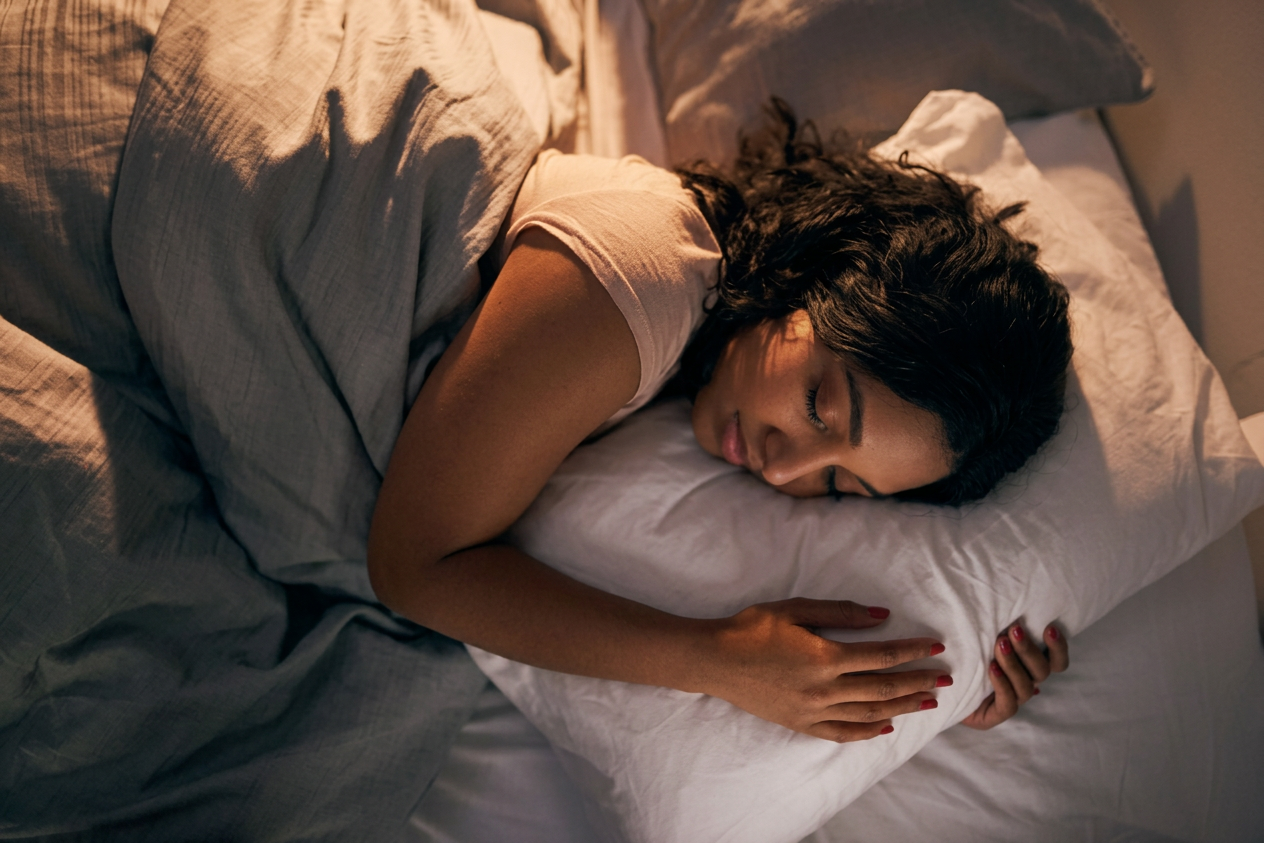
Hormonal fluctuations are often the primary disruptor of sleep quality for women, and they cannot always be controlled, but the environment and habits around sleep can be:
- A bedroom that is cool, dark, and quiet creates the conditions the brain needs to move through full sleep cycles.
- Consistent sleep and wake times, even on weekends, anchor the circadian rhythm and reduce the fragmentation that hormonal variation causes.
- Reducing screen light in the hour before bed protects the melatonin signal that initiates sleep.
Stress is another factor that affects women’s sleep disproportionately. Research on the default mode network, the brain system active during rest and rumination, shows that women tend to process emotional information more extensively during quiet periods, which can make the transition to sleep harder when the mental load of the day has not been adequately discharged. A brief pre-sleep routine, prayer, journaling, or simply sitting quietly without a screen gives the brain a structured opportunity to wind down before the bedroom becomes associated with wakefulness.
The goal is not perfect sleep. It is an honest reckoning with what the body needs and a willingness to protect it rather than treat it as optional.
This Week
- Audit your actual sleep hours honestly. Not what you aim for, but what you are actually getting. If the answer is consistently under seven hours, treat that as health information, not a scheduling inconvenience.
- Notice where your sleep is fragmented. Do you fall asleep easily but wake at 2 or 3 am? Do you sleep lightly and wake at sounds? Identifying the pattern helps address the cause.
- Keep your sleep and wake time consistent. The body’s circadian rhythm responds to regularity. Sleeping in on weekends feels restorative, but actually shifts the rhythm and makes Monday harder.
- Make your bedroom cooler and darker. The body’s core temperature needs to drop to initiate and sustain deep sleep. A cool, dark room supports that process naturally.
- Build a wind-down habit before bed. Ten to fifteen minutes of prayer, journaling, or quiet reading signals to the brain that the day is ending. Replace the scroll with something that settles rather than stimulates.
- If hormonal disruption is persistent, speak to a doctor. Night sweats, restless legs, and sleep apnea are medical conditions, not inconveniences to manage alone. A doctor can help.
Bottomline
The tiredness many women carry is not weakness, not poor time management, and not something that more discipline will fix. It is, in many cases, a biological reality that the body is communicating as clearly as it can. The female brain works harder during the day. Female hormones create recurring disruptions to sleep quality across decades of life. And the consequences of consistently undervaluing that need reach into the systems that keep a woman’s heart, mind, and immune system functioning.
You were not designed to run on empty. The body God gave you was built with a need for rest woven into its design from the beginning, and honouring that need is not self-indulgence. It is stewardship of the one life you have been given to live.
Sleep more. Sleep well. And stop apologizing for needing to.
“...He grants sleep to those he loves” (Psalm 127:2, NIV).
Citations
- Horne JA. Sleep Research Centre, Loughborough University. Women’s brains, multitasking, and sleep. 2013. View source
- ScienceInsights. Why women need more sleep: hormones and brain science. ScienceInsights. 2026. View article.
- Cleveland Clinic. Why women need more sleep than men. Cleveland Clinic Health Essentials. 2024. View article
- Healthline. Do women need more sleep than men? Healthline. Updated May 2026. View article
- University of Pittsburgh. Women sleeping under five hours per night at 75% higher cardiovascular risk. Reported via Earth.com. 2024. View article
- University of Warwick. New study says women’s health much more at risk from sleep deprivation. University of Warwick Press Release. View article
- Shah AS, et al. Effects of sleep deprivation on physical and mental health outcomes: an umbrella review. Health Promot Perspect. 2025. View on PubMed


