
Before Moses chose faith, his parents did.
Before Moses ever stood before Pharaoh, before he stretched out a rod over the Red Sea, before he chose to identify himself with the people of God, there were two parents who had already made a choice.
They chose faith.
Their names were Amram and Jochebed (Exodus 6:20).
They lived under the rule of a king who feared the growing population of Israel. Pharaoh had already subjected the Israelites to harsh labour. When that failed to stop their growth, he devised something far more terrible.
Every Hebrew son who was born was to be cast into the river.
Then Moses was born.
Hebrews remembers what happened next in one remarkable sentence:
“By faith Moses, when he was born, was hidden three months by his parents, because they saw he was a beautiful child; and they were not afraid of the king’s command” (Hebrews 11:23, NKJV).
Notice where Hebrews begins, “By faith.”
Their courage did not begin with confidence in themselves. It began with confidence in God. Before they had the courage to face the king, they had learned to trust the King above all kings.
Faith gives courage to act when we can and courage to surrender when we cannot.
That is the story of Moses’ parents.
Faith in a hostile world
Exodus 1 tells us that a new Pharaoh arose who did not know Joseph (Exodus 1:8).
Joseph had once been the means through which Egypt survived famine. His family had once been welcomed into the land.
Now their descendants had become a perceived threat.
Pharaoh said, “Come, let us deal shrewdly with them” (Exodus 1:10, NKJV). What followed was oppression. The Israelites were forced into hard labour. Yet the more they were afflicted, the more they multiplied (Exodus 1:12).
Pharaoh’s fear intensified.
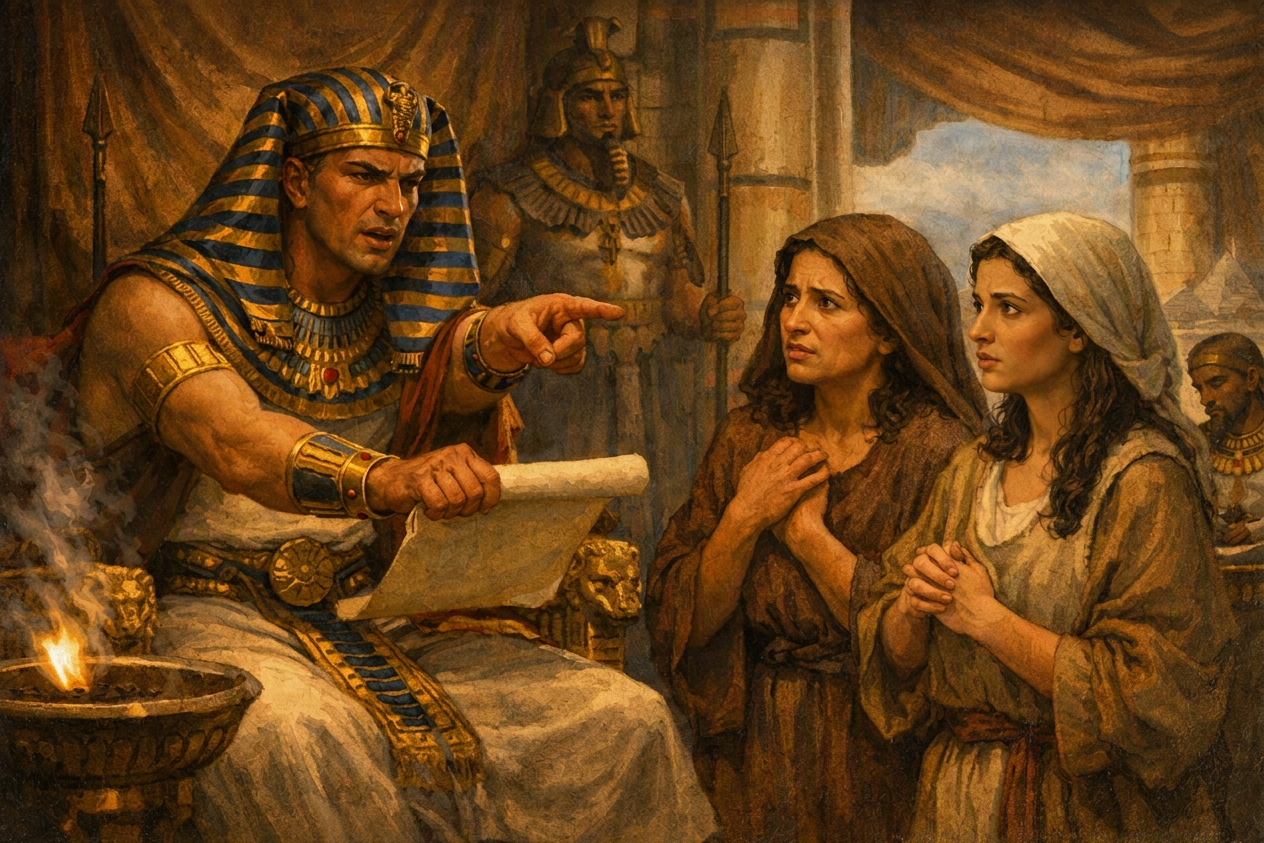
He commanded the Hebrew midwives to kill the male children at birth. But the midwives “feared God” and refused (Exodus 1:17).
That phrase becomes important. They feared God more than Pharaoh. God blessed them for their faithfulness.
Then Pharaoh made the command even more severe:
“So Pharaoh commanded all his people, saying, 'Every son who is born you shall cast into the river, and every daughter you shall save alive” (Exodus 1:22, NKJV).
This was the world into which Moses was born. It was not a safe world. It was not a friendly world.
And yet it was precisely in that world that faith was born into action.
Faith sees more than circumstances
“By faith Moses, when he was born, was hidden three months by his parents…”
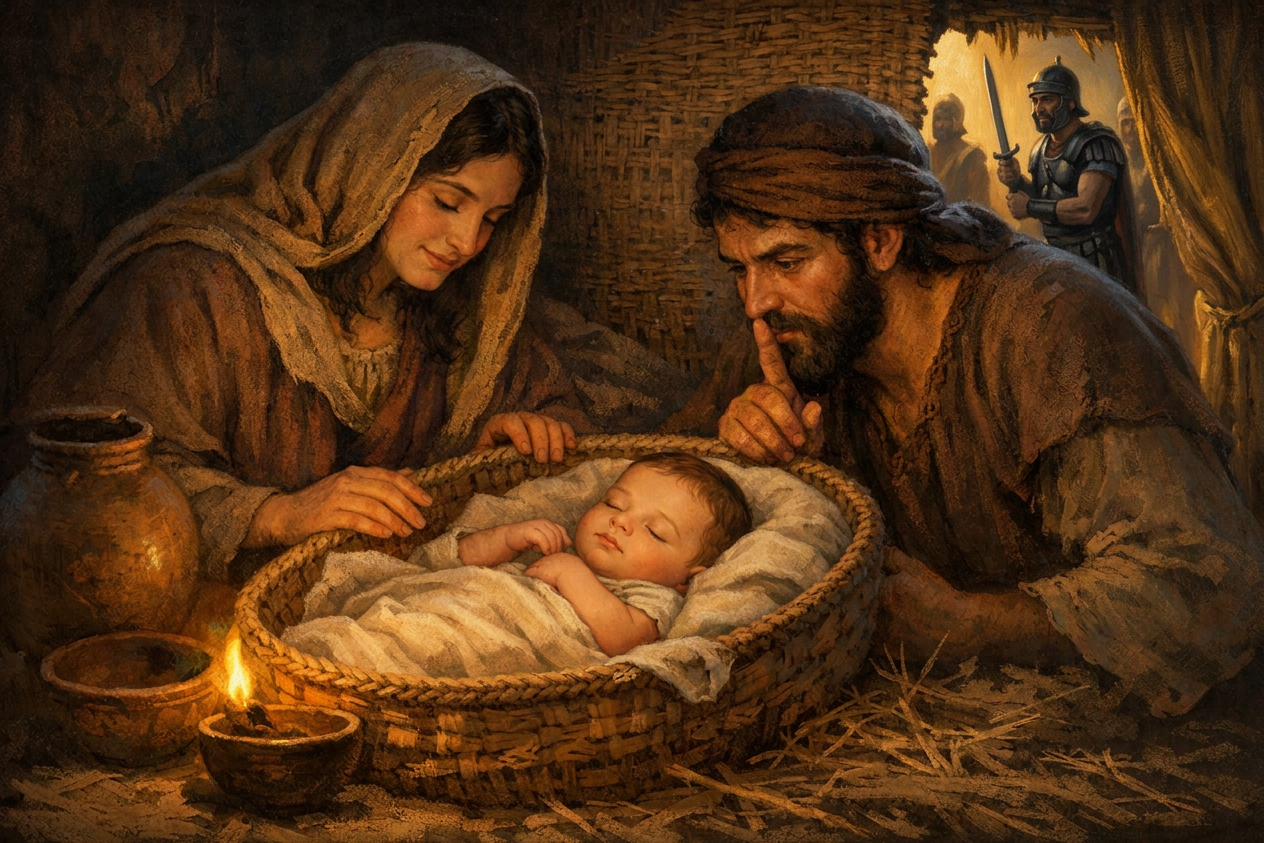
Exodus 2 tells us that Jochebed saw that her son was a “beautiful child” and hid him for three months (Exodus 2:2).
The writer of Hebrews does not tell us that the parents knew every detail of what God would do.
They did not have a complete plan. They did not know that Pharaoh’s daughter would find Moses. They did not know that Moses would grow up in the palace. They did not know that he would eventually lead Israel out of Egypt. They knew only what faith had given them.
They knew God.
And they knew that this child was worth protecting. Hebrews says they “were not afraid of the king’s command.”
That does not mean they felt no fear. They were parents living under a death sentence imposed on their son.
Their situation was terrifying.
But biblical courage is not the absence of fear.
It is choosing obedience to God when fear is present.
Faith does not necessarily make danger disappear. It gives us someone greater than danger to trust.
Tweet
Faith acts when obedience is costly
For three months, Moses was hidden. Think about what that required:
- Silence
- Carefulness
- Constant vigilance
- A baby cries
- A baby needs attention
- A baby cannot understand the danger surrounding him
His parents could not simply relax and assume everything would work out. Their faith produced action.
They hid him. This is important because faith in Scripture is never merely intellectual agreement.
James later reminds us:
“Faith by itself, if it does not have works, is dead” (James 2:17, NKJV).
Amram and Jochebed believed enough to act. They could not control Pharaoh. But they could choose what they would do with the child God had entrusted to them.
Faith did not make them passive. Faith made them courageous.
When faith must surrender
But then came the moment every parent fears.
“But when she could no longer hide him…” (Exodus 2:3, NKJV).
There is something deeply human about that sentence. Jochebed had done everything she could. But eventually, hiding Moses was no longer possible.
What does faith do when our ability to protect, control, or solve the situation reaches its limit?
It surrenders.
Jochebed made a little ark of bulrushes and covered it with waterproofing material. She placed Moses inside and set him among the reeds at the river’s edge (Exodus 2:3).
The river that Pharaoh had intended to become an instrument of death became the place where God began Moses’ deliverance.
That little ark was not a guarantee. Jochebed could not see the future. She could not see Pharaoh’s daughter approaching. She could not see Miriam watching nearby. She could not see how God would arrange every detail.
She simply entrusted her child to God.
Faith gives courage to act when we can and courage to surrender when we cannot.
God works beyond what we can see
Miriam stood at a distance, watching to see what would happen to her little brother (Exodus 2:4).
Then Pharaoh’s daughter came down to the river, saw the ark, opened it, and the baby cried. And she had compassion on him (Exodus 2:5–6).
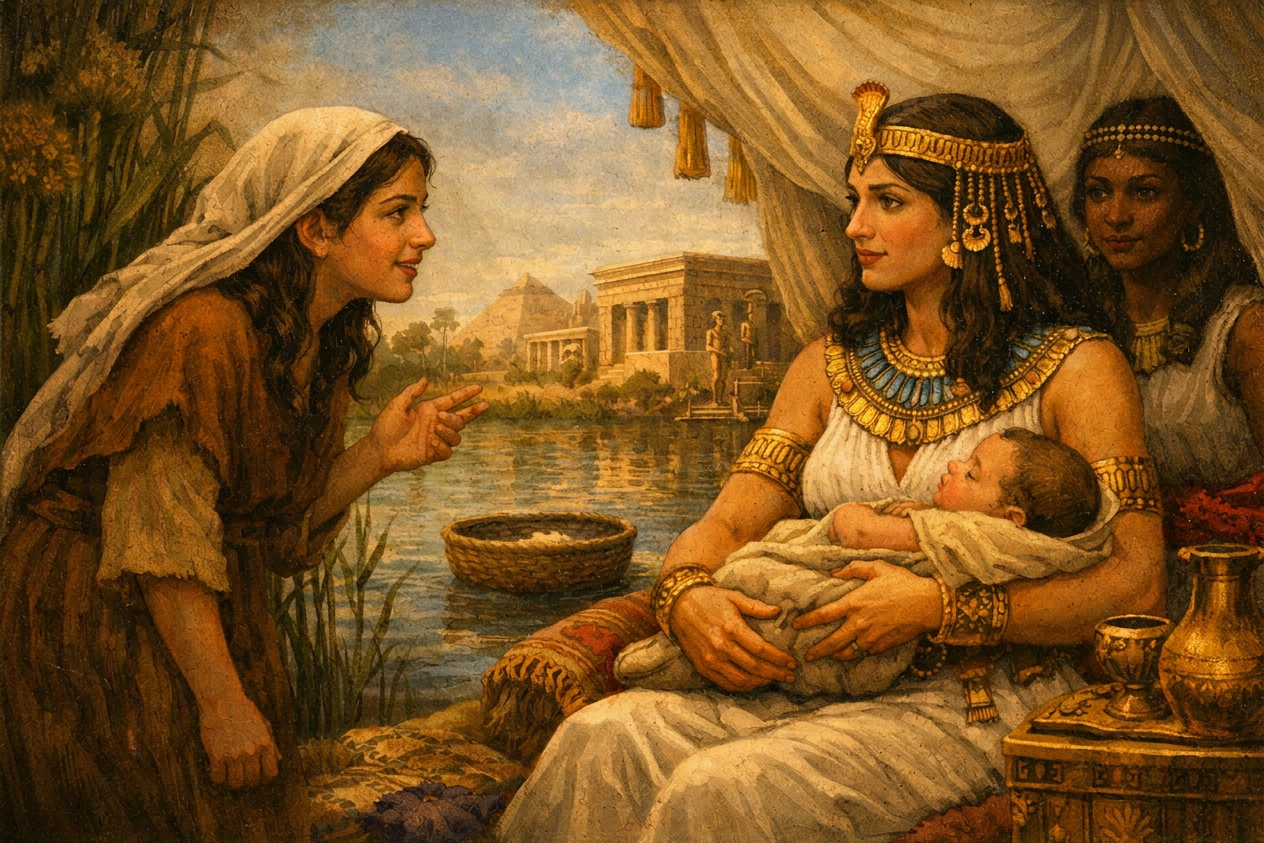
Then Miriam stepped forward.
“Shall I go and call a nurse for you from the Hebrew women, that she may nurse the child for you?” (Exodus 2:7, NKJV).
Pharaoh’s daughter agreed. And who did Miriam bring? Jochebed. Moses’ own mother.
The woman who had been forced to release her son into God’s care was given the opportunity to care for him again. And Pharaoh’s daughter even paid her to do it. What a picture of providence!
Jochebed could not see how God would answer her prayers. But God was already working. The child Pharaoh wanted dead was rescued from the river. The mother who feared losing her son was given him back. And the child destined to become the deliverer of Israel was raised under the protection of Pharaoh’s own household.
God did not simply preserve Moses; He overruled Pharaoh’s plan.
Faith raises what God has entrusted
Jochebed eventually had to give Moses back.
But before that happened, she had an opportunity that would shape the rest of his life. She taught him. Exodus does not record the details of those years, but it tells us enough to see their significance.
Moses would eventually be raised in Pharaoh’s household. He would receive the education of Egypt. He would be surrounded by its wealth, power, religion, and culture. Yet the influence of his earliest years remained.
Hebrews 11:24–26 will soon tell us that Moses, when he was grown, refused to identify himself permanently with Pharaoh’s household and chose the reproach of Christ instead.
The faith of his parents preceded the faith of their son. Their courage before Pharaoh helped preserve his life. Their teaching helped shape his convictions. And eventually Moses would have to make his own choice.
That is an important lesson for every parent and grandparent.
We cannot choose faith for our children, but we can introduce them to the God who is worthy of their faith.
We can teach them Scripture. We can model prayer. We can demonstrate integrity. We can show them what it looks like to trust God when circumstances are difficult. We can create an environment in which faith is not merely talked about but lived.
Then, eventually, they must choose.
Faith against the fear of man
Hebrews says, “…they were not afraid of the king’s command”.
This is the part of their story that Hebrews deliberately remembers.
Pharaoh had authority, soldiers, laws, and the power to make their lives dangerous. But Pharaoh was not God. The parents’ faith put the king’s authority in its proper place.
There is a recurring biblical principle here:
“We ought to obey God rather than men” (Acts 5:29, NKJV).
This does not mean Christians should become needlessly rebellious or disrespectful toward earthly authorities.
Scripture teaches believers to respect governing authorities (Romans 13:1–7).
But when human authority directly commands what God forbids—or forbids what God commands—faith knows where ultimate allegiance belongs.
Amram and Jochebed faced precisely that kind of moment.
And their faith answered.
God’s command mattered more than the king’s command.
From the Conflict of the Ages Series
Ellen G. White connects their courage directly to their faith in God:
“While this decree was in full force a son was born to Amram and Jochebed, devout Israelites of the tribe of Levi. The babe was ‘a goodly child;’ and the parents, believing that the time of Israel’s release was drawing near, and that God would raise up a deliverer for His people, determined that their little one should not be sacrificed. Faith in God strengthened their hearts, ‘and they were not afraid of the king’s commandment.’”
— Ellen G. White, Patriarchs and Prophets, p. 242
This is precisely the connection Hebrews makes. Their courage did not arise from human fearlessness.
“Faith in God strengthened their hearts.”
Their faith gave them the courage to act. And when their ability to act reached its limit, that same faith enabled them to entrust Moses to God.
Looking unto Jesus
The story of Moses’ parents ultimately points us beyond Moses.
They protected a child whom God would use to deliver Israel from physical bondage. But Scripture’s greater story is about a Deliverer who came to save humanity from sin.
Moses was preserved from Pharaoh. Christ willingly entered the reach of those who sought His life.
Moses was placed in an ark and preserved through the waters. Christ passed through death itself and rose again.
Moses eventually led Israel out of Egypt. Jesus is the greater Deliverer who leads His people from the bondage of sin into the freedom of salvation.
And Moses’ parents remind us that God’s purposes cannot be defeated by human opposition.
Pharaoh wanted Israel’s sons destroyed. God was preparing Israel’s deliverer.
Herod later sought the death of the infant Jesus (Matthew 2:13–18). Yet God’s purpose could not be stopped.
The kingdom of God moves forward not because human rulers cooperate with it, but because God remains faithful to His word.
Living by Faith Today
The story of Moses’ parents speaks especially powerfully to those entrusted with others.
- Faith begins with God, not circumstances. Their courage did not begin when Pharaoh issued his decree. It began with their confidence in God. When circumstances become frightening, return to what you know about God’s character.
- Faith acts when action is possible. Jochebed did not simply pray while doing nothing. She hid Moses. Faith and obedience belonged together. Ask yourself: What faithful action is God asking me to take today?
- Faith surrenders when control ends. There came a point when Jochebed could no longer hide Moses. She had to release him. Some situations cannot be controlled, solved, or protected by human effort. Faith knows when to act and when to place the outcome in God’s hands.
- Faith influences the next generation. Moses’ parents could not determine his entire future. But they could shape his earliest understanding of God. What are the children watching us believe? Do they see us trust God only when things go well? Or do they see faith when life becomes frightening?
- Faith remembers who the real King is. Pharaoh had power, but God had the promise. Pharaoh could issue a command, but God could overrule it. And the same God who strengthened the hearts of Moses’ parents is still worthy of our trust.
Faith focus
Faith gives courage to act when we can and courage to surrender when we cannot.
Tweet
Moses’ parents could not control Pharaoh. They could not guarantee Moses’ safety. They could not see the future. But they could trust God. So they hid their son. And when they could hide him no longer, they placed him in an ark and committed him to God’s care.
They acted faithfully. Then they surrendered faithfully. And God worked beyond what they could see. Their faith did not make them fearless people. It made them people who trusted God more than they feared the king.
Before Moses ever stood before Pharaoh, his parents had already demonstrated the kind of faith he would one day need.
They trusted God with a child.
Moses would eventually trust God with a nation.
The faith of Moses’ parents preserved the life of a child who would one day face the greatest decision of his own life. Moses would have everything Egypt could offer: position, privilege, education, and power.
But when he became a man, he would have to decide where his true allegiance belonged.
Hebrews remembers that choice, “By faith Moses, when he became of age, refused to be called the son of Pharaoh’s daughter…” (Hebrews 11:24, NKJV).
Next, we’ll look at By Faith Moses… Faith That Chooses
By faith they overcame their world. By faith we overcome ours.
“For whatever is born of God overcomes the world. And this is the victory that has overcome the world—our faith” (1 John 5:4, NKJV).


