
Have you ever opened your Bible with every intention of reading, only to find your eyes glazing over by the second paragraph? Have you read the same verse three times and still have no idea what it says? Have you fallen asleep mid-psalm, woken up with the Bible on your face, and then felt vaguely guilty about the whole thing?
You are not alone. Once you understand what your brain actually needs to engage with written text, reading the Word stops feeling like a discipline you are failing at and starts becoming something your whole self can lean into.
We will cover:
Let us start with the brain, because understanding why attention wanders changes how you work with it instead of against it.
Why your brain keeps switching off

The brain’s default mode network, the system that activates when you are not focused on an external task, is one of the most active networks in the entire brain. Research published in Psychological Bulletin found that the mind wanders from the task at hand almost 47% of the time during everyday activities.[1] There is absolutely nothing wrong with this. It is the brain doing what it was designed to do: constantly scanning, processing background thoughts, preparing for what comes next.
The challenge with reading, especially complex or unfamiliar text, is that it requires sustained attention, which is the brain’s least automatic mode. The moment engagement drops even slightly, the default network kicks back in, and you are suddenly thinking about what to cook for dinner or replaying a conversation from last week, while your eyes continue moving across the page, producing nothing.
This is compounded by how most people approach Bible reading: at the end of a long day, in a comfortable position, in a quiet environment that the brain associates with rest. The conditions are almost perfectly calibrated for sleep, not for deep engagement with ancient text. The brain is not being disrespectful to the Word. It is responding to the conditions you have given it.
Which brings us to the most underestimated factor in Bible reading: when you do it.
Can your Bible reading timing affect your concentration?
A review published in the Yale Journal of Biology and Medicine mapped how attention changes across the day according to circadian rhythms.[2]
Sustained attention, the kind needed for deep reading and comprehension, peaks between mid-morning and early afternoon for most people. It drops significantly in the post-lunch window between 1 pm and 3 pm and declines again in the late evening as the brain begins preparing for sleep.
Many Christians read their Bible last thing at night, which is devotionally meaningful but cognitively demanding. The brain at 10 pm is not in its best state for new learning or deep processing. It is winding down, and the comfortable, low-stimulus nature of reading in bed accelerates that winding.
This does not mean evening devotions are wrong. It means that if you consistently fall asleep during them, your body is telling you something worth listening to. Shifting your Bible reading to the morning, even 15 focused minutes before the day, builds momentum and works with your brain’s natural peak rather than against it. Joshua 1:8 describes meditating on the Word day and night, and the pattern in Scripture of seeking God in the morning, as Jesus did in Mark 1:35, is not coincidental. It reflects a rhythm the body itself was built for.
Timing matters. But how you read matters just as much.
How to read in a way that actually sticks
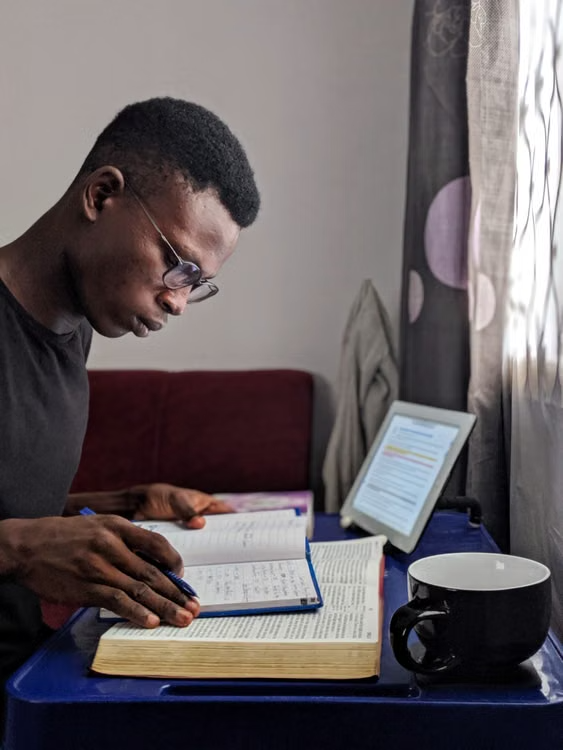
Neuroscientists at Emory University found that reading narrative text, stories with characters, conflict, and emotional stakes, produces measurably stronger brain connectivity than reading neutral or expository text.[3]
The brain responds to a story the way it responds to lived experience: it activates motor, sensory, and emotional regions, not just the language processing areas. The Bible is full of narrative, and reading it as a story rather than as a text to be endured produces a fundamentally different cognitive experience.
Reading less but more slowly is another evidence-based shift.
The brain consolidates meaning through processing time, not through volume.
Reading three chapters quickly and retaining nothing is less valuable than sitting with three verses until they open up. Ellen G. White captures this beautifully:
“In daily study the verse-by-verse method is often most helpful. Let the student take one verse, and concentrate the mind on ascertaining the thought that God has put into that verse for him, and then dwell upon the thought until it becomes his own. One passage thus studied until its significance is clear is of more value than the perusal of many chapters with no definite purpose in view and no positive instruction gained.”
— Education, p. 189.4 (Ellen Gould White)
That is not a spiritual instruction in conflict with the brain’s design. It is perfectly aligned with how memory and comprehension are actually built.
Writing while you read is one of the most reliable engagement tools available. The act of writing activates different neural pathways from reading alone, forcing the brain to process and translate what it has received rather than passively receiving it. A simple practice: read a passage, then write one sentence in your own words about what you just read. Not a summary. Your response to it. That shift from passive reception to active processing is often the difference between reading that evaporates and reading that stays.
Praying before you open the Bible is also more than a spiritual habit. It is an attentional cue, a way of signalling to the brain that what follows requires focus and intention. The brain responds to prepared states. When you approach the Word with deliberate expectation rather than routine obligation, the quality of engagement reflects that difference.
Put these together, and the reading session that used to feel like a battle against your own eyes becomes something entirely different.
This Week
Pick one change from each area and try it consistently for seven days.
- Move your reading to the morning. Even 10 to 15 minutes before the day takes over. Your brain is better equipped to engage than at the end of a full day. If mornings are genuinely impossible, try mid-morning or late afternoon rather than late at night.
- Read less, go slower. Choose one passage, one story, or even one chapter rather than a reading plan quantity. Read it twice. Ask: What is actually happening here? What does this tell me about God? What does it say to me today?
- Write one sentence after every reading. Not a Bible study note. One honest sentence: what struck you, what confused you, what you want to hold onto. Writing it moves it from the page into your memory.
- Pray before you open it, every time. Ask the Holy Spirit to open your eyes to what you are about to read. Psalm 119:18 frames it perfectly: open my eyes that I may see wonderful things in your law. That prayer changes the posture of the whole session.
- Remove the phone from the room. The presence of a smartphone, even face down and silent, has been shown to reduce available cognitive capacity. Your Bible reading deserves your undivided attention, and your brain will give you what the environment allows.
Bottomline
Falling asleep during Bible reading is not evidence that you do not love God, but often evidence that you are tired, that you are reading at the wrong time of day, in the wrong conditions, in a way that the brain finds difficult to sustain. Change the conditions, and the experience changes with them.
God gave you a brain that runs on rhythms, that responds to story, that learns through repetition and active engagement. Reading His Word in alignment with those rhythms is not unspiritual. It is stewardship of the very instrument. He gave you to receive it.
The Word is living and active (Hebrews 4:12). It does not need you to be perfect before you come to it. It needs you to come, honestly, with whatever focus you have, and to keep coming back. The rest happens in the encounter.
“Open my eyes, that I may see wondrous things from Your law” (Psalm 119:18, NKJV).
Citations
- Smallwood J, Schooler JW. The restless mind. Psychol Bull. 2006;132(6):946-958. View on PubMed
- Valdez P. Circadian rhythms in attention. Yale J Biol Med. 2019;92(1):81-92. View on PMC
- Berns GS, et al. Short- and long-term effects of a novel on connectivity in the brain. Brain Connectivity. 2013;3(6):590-600. View on PubMed


This has been so helpful . Actually,it does also happen occasionally when I pray,you suddenly find yourself dozing and repeating a certain word in prayer severally. I hope to do better now that I have diagnosed a problem.
Gd bless you.
LikeLike
May God bless you. I have learnt of my poor habits during devotion and now I hope to be better and much better
LikeLike