Some promises are difficult to wait for. Others become difficult to believe. Sarah knew the difference.
God had promised Abraham that through him a great nation would arise. His descendants would become numerous, and through his seed all the families of the earth would be blessed (Genesis 12:2–3).
There was only one problem. Sarah had no children. And she knew that before having a great nation, Abraham at least needed a son.
Years passed. Then decades. The promise remained, but the circumstances seemed increasingly determined to contradict it.
Eventually, Sarah reached an age when motherhood was no longer merely unlikely—it was humanly impossible.
Yet Hebrews remembers her with these remarkable words:
“By faith Sarah herself also received strength to conceive seed, and she bore a child when she was past the age, because she judged Him faithful who had promised” (Hebrews 11:11, NKJV).
Notice what Hebrews emphasises.
It does not say Sarah understood how God would do it. It does not say she never struggled. Instead, she judged Him faithful who had promised.
That is where Sarah’s faith found its foundation. Not in the possibility of the promise, but in the faithfulness of the Promiser.
She introduces us to the waiting aspect of faith.
Faith has to wait

We live in a culture that values immediacy.
We want quick answers, instant communication, rapid results, and solutions on demand. Waiting can feel like wasted time. But God’s promises often require patience. Abraham and Sarah had received God’s promise, but the fulfilment did not come according to their timetable.
Eventually, Sarah tried to solve the problem herself.
Genesis 16 tells the painful story of Hagar and Ishmael. Sarah’s attempt was understandable from a human perspective, but it revealed what happens when we become impatient with God’s timing.
The promise was God’s. But Sarah attempted to produce its fulfilment through human means. That is one of the most subtle temptations of faith.
We believe God’s promise, but we become uncomfortable with God’s timetable. So we try to help Him. We manipulate circumstances. We force doors open. We manufacture solutions. We take control. Oh yes! We try to charge and help God!
And sometimes our greatest struggle is not unbelief in God’s promise, but impatience with His process.
Sarah’s story teaches us that faith does not merely believe God’s promise; faith learns to wait for God’s way of fulfilling it.
Let’s see how Sara laughs when divine reassurance comes her way
When Sarah laughed
Then came the moment when the promise seemed almost absurd. God visited Abraham and reaffirmed that Sarah would have a son.
Sarah was listening from inside the tent. She heard the promise. Then she considered the reality.
“Therefore Sarah laughed within herself, saying, ‘After I have grown old, shall I have pleasure, my lord being old also?’” (Genesis 18:12, NKJV).
Her laughter reveals the tension between faith and sight. She saw age—old age. She saw biological limitations. She saw years of disappointment. But God saw a promise He was fully capable of keeping.
Then came the divine question:
“Is anything too hard for the LORD?” (Genesis 18:14, NKJV).
That question reaches far beyond Sarah. It reaches us.
What have we quietly concluded is impossible? What promise of God have we begun to measure against our circumstances rather than against His character? What situation have we placed in the category of “God cannot do this anymore”?
Sarah’s story reminds us that God’s ability is not limited by our circumstances.
Faith is not the absence of struggle
There is something deeply encouraging about Sarah’s story.
Her faith was not perfect from the beginning. She laughed, doubted, and tried another solution.
Yet Hebrews still says:
“By faith Sarah herself also received strength...” (Hebrews 11:11, NKJV).
This should give hope to anyone who has ever struggled to believe.
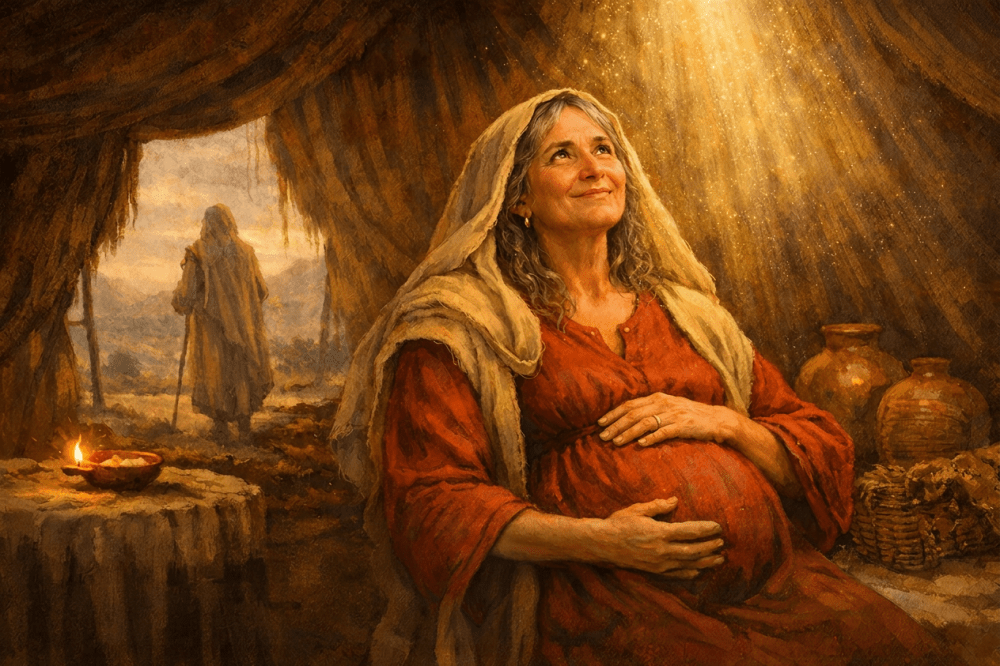
Biblical faith is not pretending that difficulties do not exist. It is bringing those difficulties into the presence of a faithful God. Sarah’s journey demonstrates that faith can grow in the soil of weakness. She did not become strong because her circumstances changed first. Her circumstances changed because God remained faithful despite her weakness.
And Hebrews identifies the decisive change in her thinking:
“She judged Him faithful who had promised.”
Sarah learned to evaluate her circumstances through God’s character rather than evaluating God through her circumstances.
That is faith.
The promise became a person
Eventually, the laughter became joy.
Sarah conceived and gave birth to Isaac. The impossible happened. But Isaac was not the final fulfilment of everything God had promised Abraham.
The promise extended much further.
God had said:
“In you all the families of the earth shall be blessed” (Genesis 12:3, NKJV).
Centuries later, Paul explains that the ultimate Seed of Abraham is Christ:
“Now to Abraham and his Seed were the promises made. He does not say, ‘And to seeds,’ as of many, but as of one, ‘And to your Seed,’ who is Christ” (Galatians 3:16, NKJV).
Sarah’s miracle was therefore part of a much larger story.
God was not simply giving an elderly woman a child. Rather, He was advancing His plan of redemption. For the promised son would continue the covenant line through which the promised Saviour would eventually come.
Sarah’s faith was connected to something far greater than her own circumstances.
And life pushes all of us to such corridors this side of eternity.
When we have tried everything
Perhaps one reason Sarah’s story resonates so deeply is that she knows what it means to reach the end of human possibility.
There comes a point when our resources run out, our strength fails, our plans collapse, and our years of experience offer no solution. And sometimes that is precisely where God wants us to discover something about Himself.
We often pray, “Lord, change my circumstances.” Sometimes God’s deeper work is, “Learn who I am in the middle of your circumstances.”
Sarah eventually discovered that the question was never whether she was capable. The question was whether God was faithful.
And He was. We too can live by Sarah’s faith today
Living by Sarah’s faith today
We may not be waiting for the birth of a promised child. But we all know what it means to wait:
- We wait for healing
- We wait for reconciliation
- We wait for direction
- We wait for a prodigal child to return
- We wait for an opportunity
- We wait for an answer to prayer
- We wait for Christ’s return
And sometimes the hardest part is watching the calendar while wondering whether God has forgotten.
To all of us in the waiting period, Sarah tells us:
God’s silence is not God’s absence.
The delay does not mean the promise has failed. And when God’s answer does not come in the way we expected, faith still has somewhere to stand.
It stands on the character of God.
“For He who promised is faithful” (Hebrews 10:23, NKJV).
Faith waits because it knows the Promiser.
Let’s now take a look at the devotional input for the series.
From the Conflict of the Ages Series
Ellen White reflects on Sarah’s journey and the lesson of trusting God’s promise despite human impossibility:
“Abraham had accepted without question the promise of a son, but he did not wait for God to fulfill His word in His own time and way. A delay was permitted, to test his faith in the power of God; but he failed to endure the trial. Thinking it impossible that a child should be given her in her old age, Sarah suggested, as a plan by which the divine purpose might be fulfilled, that one of her handmaidens should be taken by Abraham as a secondary wife. Polygamy had become so widespread that it had ceased to be regarded as a sin, but it was no less a violation of the law of God, and was fatal to the sacredness and peace of the family relation. Abraham’s marriage with Hagar resulted in evil, not only to his own household, but to future generations.”
— Ellen G. White, Patriarchs and Prophets, p. 145
Sarah’s experience brings this truth into sharper focus. Faith does not rest upon the strength of the person who believes. It rests upon the faithfulness of the God who has promised.
Our confidence is therefore not, “I can believe strongly enough.” Instead, it is, “God is faithful enough.”
And so we learn to look unto Jesus.
Looking unto Jesus
Sarah’s story ultimately points us beyond Isaac.
The miracle was not merely that an elderly woman conceived. The greater miracle was what God was accomplishing through the promised seed.
Through Isaac came Jacob. Jacob became Israel, and from Israel came a covenant people. Through that people came the covenant promises. And through those promises came Christ, the promised Seed through whom all the nations of the earth would be blessed.
Paul reminds us:
“And if you are Christ's, then you are Abraham's seed, and heirs according to the promise” (Galatians 3:29, NKJV).
The promise made to Abraham and Sarah eventually reaches us through Jesus.
That means Sarah’s story is not merely about believing God for an impossible personal outcome. It is about learning to trust the God whose purposes are infinitely larger than our own.
Sometimes God fulfils a promise exactly as we hoped, and sometimes He fulfils it differently. Sometimes the fulfilment arrives in our lifetime, while sometimes we die still waiting.
Hebrews 11 itself reminds us that many faithful people “died in faith, not having received the promises, but having seen them afar off” (Hebrews 11:13, NKJV).
The ultimate promise is therefore not merely an earthly answer, but Christ. And because Christ has come, died, risen, and promised to return, we can trust God even when we cannot yet see the outcome.
Sarah eventually held Isaac in her arms. We may not yet hold everything God has promised. But we hold something Sarah could only anticipate: the certainty that God keeps His word.
Faith does not make the impossible possible. Rather, it trusts the God for whom nothing is impossible.
And when the promise seems delayed, when circumstances seem contradictory, and when hope appears unreasonable, we can say with Sarah:
He is faithful who promised.
Faith focus
Faith waits because it knows the Promiser.
Sarah’s story teaches us to trust God when the promise seems impossible. But faith must eventually confront another question: What happens when God asks us to trust Him with something we already love?
Our journey next takes us to Isaac, where faith will teach us that trusting God sometimes means surrendering even the promise itself.
Next, we’ll look at Isaac.
By faith, they overcame their world. By faith we overcome ours.
“For whatever is born of God overcomes the world. And this is the victory that has overcome the world—our faith” (1 John 5:4, NKJV).


This faith is what I need.An encouraging piece.Am grateful for this.
LikeLiked by 1 person
Faith is the victory 🙌
LikeLiked by 1 person