
“Where were you when I laid the foundations of the earth? Tell Me, if you have understanding” (Job 38:4, NKJV).
Context
There are moments when we desperately want God to explain Himself.
- Why did this happen?
- Why did You allow it?
- Why has the suffering continued?
- What purpose could possibly come from this?
Job knew something about such questions.
His story begins with an extraordinary blessing. He is described as “blameless and upright” (Job 1:1), a man who feared God and had been blessed with family, possessions, and influence. Yet, in a matter of hours, his world collapses.
His children die. His possessions disappear. His health fails. The man who had once enjoyed abundance finds himself sitting in ashes, struggling to understand a life that no longer makes sense.
His friends arrive, but their attempts to explain his suffering only make matters worse. They assume that suffering must be evidence of hidden sin. Job knows their explanation cannot account for what has happened to him, and he longs for an opportunity to bring his case before God.
Eventually, God speaks. But He does not begin by explaining why Job suffered.
Instead, He asks questions.
The first is:
“Who is this who darkens counsel by words without knowledge?” (Job 38:2)
Then comes another:
“Where were you when I laid the foundations of the earth?”
God is taking Job somewhere he has not been before. Instead of explaining his circumstances, He gives him a deeper revelation of the One who governs the universe. God takes Job back to creation.
When God speaks of creation
Job had spent much of the book trying to understand his circumstances. He knew what had happened to him, but he could not understand why.
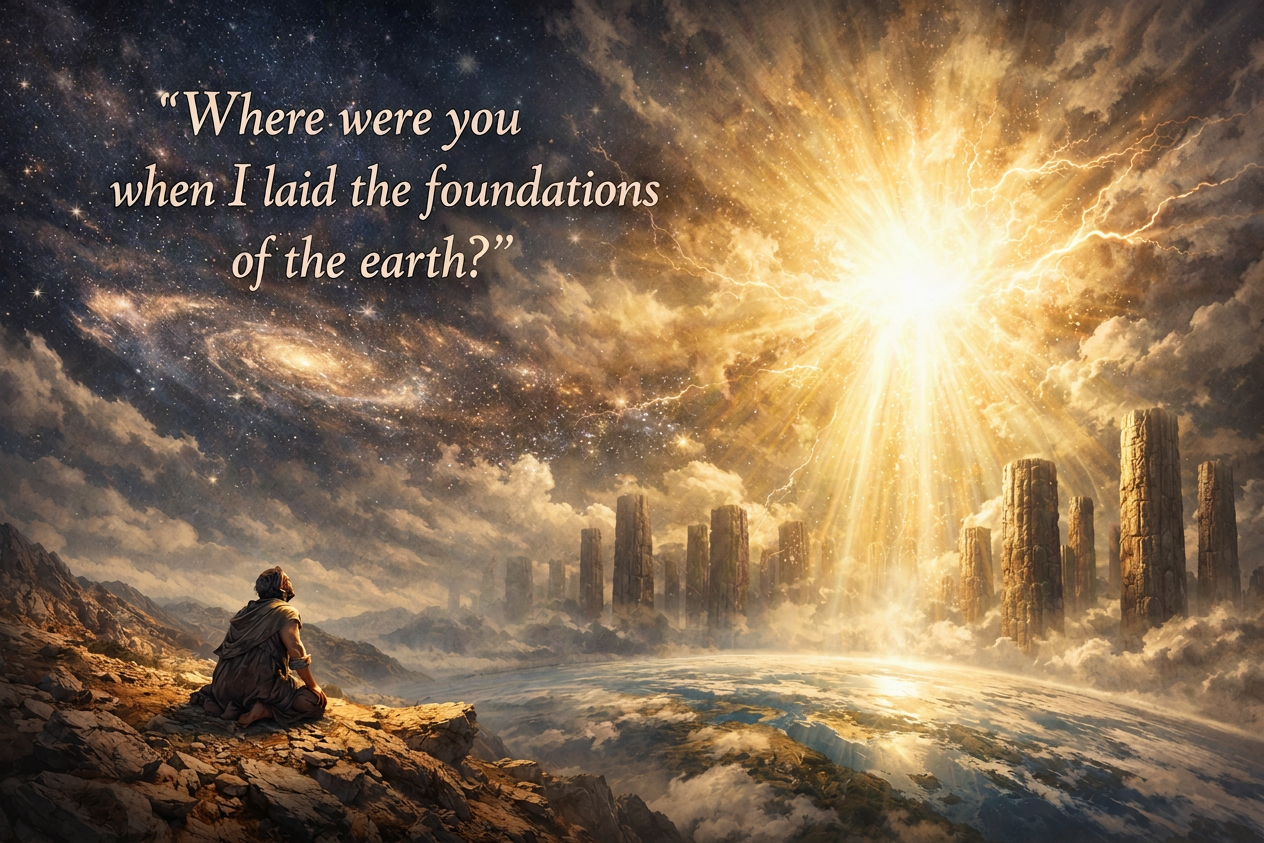
God’s response begins by placing Job’s experience within a much larger reality.
“Where were you when I laid the foundations of the earth?”
The question takes Job beyond his immediate suffering and back to the beginning of creation.
Before Job was born, God was there. Before Job experienced prosperity, God was there. Before Job experienced loss, God was there. Before human beings ever wrestled with questions about suffering, the Creator already possessed perfect knowledge. God is reminding Job that the universe did not begin with Job’s understanding of it.
And neither does God’s wisdom end where human understanding reaches its limit.
This is why the opening of Job 38 is so remarkable. God does not merely speak about creation; He speaks as the Creator.
And the way He starts the questioning is even more remarkable.
“Where were you?”
The question is simple, but its implications are enormous:
“Where were you…?”
Job was not there.
He did not witness the creation of the earth. He did not establish its foundations. He did not determine its measurements or set its boundaries.
God did.
The point is not to humiliate Job. It is to help him recognize the difference between human knowledge and divine knowledge.
While Job knows something, only God knows everything. In his human limitation, Job sees one part of the story, yet God sees the whole. Job experiences time moment by moment, but God sees history in its entirety.
That distinction becomes especially important when we face circumstances we cannot explain. We naturally interpret life from what we can see. God does not have that limitation.
Notice the final words of the question:
“Tell Me, if you have understanding.”
God is not asking Job to provide information He lacks. He is inviting Job to recognize the limits of his own knowledge.
And sometimes recognizing those limits is the beginning of wisdom. When God starts speaking about the foundations of the earth, we have to listen.
The foundations of the Earth
God’s description of creation is breathtaking.
“Who determined its measurements? Surely you know!” (Job 38:5, NKJV).
He speaks of the earth’s foundations and cornerstone. He describes the morning stars singing together and the sons of God shouting for joy (Job 38:6–7). The language is poetic, majestic, and deeply theological.
Creation is not presented as accidental or meaningless. It reflects order, wisdom, purpose, and design.
The One speaking to Job is the Creator who laid the foundations of the earth.
Ellen G. White draws attention to the extraordinary character of this passage in Education:
“The earliest as well as the most sublime of poetic utterances known to man are found in the Scriptures. Before the oldest of the world’s poets had sung, the shepherd of Midian recorded those words of God to Job—in their majesty unequaled, unapproached, by the loftiest productions of human genius.”
— Ellen G. White, Education, p. 159
The observation is especially fitting here. God’s questions in Job 38 are not merely a collection of arguments. They are a majestic revelation of divine wisdom through the language of poetry.
And the subject is creation.
The Creator is directing Job’s attention to a world whose complexity and order testify to wisdom far beyond human comprehension.
What creation teaches us about the creator
There is another important lesson here. God does not answer Job’s suffering by minimizing it.
Job’s pain was real. His losses were real. His questions were real. But God knows that Job’s immediate circumstances are not the whole reality. The Creator’s perspective is infinitely larger.
This is why Scripture so often directs our attention to creation when speaking about God’s greatness.

The psalmist declares:
“The heavens declare the glory of God;
 And the firmament shows His handiwork” (Psalm 19:1, NKJV).
And Isaiah asks:
“Have you not known?
 Have you not heard?
 The everlasting God, the LORD,
 The Creator of the ends of the earth,
 Neither faints nor is weary” (Isaiah 40:28, NKJV).
The God who created the earth is not exhausted by the problems that exhaust us. The God who established its foundations is not confused by circumstances that confuse us. The God who sees the whole creation is not limited to the fragment of reality visible to us. And that is why creation can become a source of faith when providence is difficult to understand.
When we cannot see the whole picture
Job knew what had happened, but he did not know why. That distinction is familiar to many of us.
We sometimes find ourselves looking at one painful chapter of life and wondering how God could possibly bring anything good from it.
But Job 38 reminds us that we are not qualified to judge the whole story from a single chapter:
- We do not know everything God knows.
- We cannot see every consequence.
- We cannot see every heart.
- We cannot see the future.
- We cannot see the invisible realities that Scripture tells us exist beyond what our eyes can perceive.
Job could not see the heavenly scene described in chapters 1 and 2. He did not know what the reader knows. What a dramatic irony!
And that makes God’s question even more powerful. Job was trying to interpret God’s actions without having God’s perspective.
How often do we do the same? We look at an unanswered prayer and conclude that God does not care. We experience a closed door and assume God has abandoned us. We endure suffering and wonder whether God has forgotten us.
But our inability to understand God’s purposes does not mean that God has none. Sometimes faith means trusting God without having access to all the information God has.
A question that calls us to trust
The remarkable thing about God’s response to Job is that He never gives Job the explanation he originally wanted.
God does not say, “Here is what happened in heaven.” Instead, He reveals the greatness of the One who holds heaven and earth together. And something begins to change in Job.
Later, after hearing the Lord speak, Job says:
“I have heard of You by the hearing of the ear,
 But now my eye sees You” (Job 42:5, NKJV).
Job does not receive an explanation for every detail. But he receives something deeper: a clearer vision of God. His circumstances had not initially changed. Not all his questions had been answered. But his understanding of the One he was trusting had changed.
This may be one of the deepest lessons in the entire book.
Sometimes we ask God for an explanation when what we need most is deeper knowledge of the One we trust.
Faith does not mean pretending that suffering is easy or that unanswered questions do not matter. Instead, it means recognizing that God remains trustworthy even when His purposes are beyond our understanding.
Conclusion
God’s question to Job reaches across the centuries:
“Where were you when I laid the foundations of the earth?”
We weren’t there. We did not see the foundations laid. We did not witness the boundaries of the sea being established. We did not hear the morning stars sing. We do not see everything God sees.
And perhaps that is precisely the point.
There will be moments when we cannot understand what God is doing. There will be prayers whose answers seem delayed, circumstances whose purpose remains hidden, and experiences that leave us asking questions for which we have no immediate answers.


