
“And there he went into a cave, and spent the night in that place; and behold, the word of the Lord came to him, and He said to him, ‘What are you doing here, Elijah?’” (1 Kings 19:9, NKJV)
Context
Few stories in Scripture capture the highs and lows of spiritual experience as vividly as the story of Elijah.
In the previous chapter, Elijah stood on Mount Carmel before a wavering nation. For years, Israel had drifted into idolatry under the influence of King Ahab and Queen Jezebel. The worship of Baal had spread throughout the land, and many had forgotten the God of their fathers.
Then came the dramatic contest on Mount Carmel. Elijah challenged the prophets of Baal to call upon their god, while he would call upon the Lord. The God who answered by fire would be recognized as the true God. After hours of futile cries from the prophets of Baal, Elijah prayed a simple prayer, and fire fell from heaven, consuming the sacrifice, the altar, and even the water surrounding it. The people fell on their faces and declared, “…The Lord, He is God! The Lord, He is God!” (1 Kings 18:39, NKJV).
It seemed like a decisive victory.
Yet only a short time later, Elijah was running for his life.
When Jezebel threatened to kill him, fear overtook the prophet. He fled into the wilderness, overwhelmed by discouragement and exhaustion. Eventually, he arrived at Mount Horeb, the mountain where God had revealed Himself to Moses centuries earlier. There, alone and weary, Elijah found refuge in a cave.
And it was there that God asked a question:
“What are you doing here, Elijah?”
The Lord knew exactly where Elijah was. The question was not about location. It was about Elijah’s condition—his thoughts, his fears, and the journey that had brought him to this place of despair.
When victory is followed by weariness
One of the surprising lessons of Elijah’s story is that spiritual victories do not make us immune to discouragement.
We might expect Elijah to be strongest after Mount Carmel. He had witnessed one of the greatest manifestations of God’s power recorded in Scripture. He had seen the nation acknowledge the Lord. He had experienced answered prayer in dramatic fashion.
Yet it was after this triumph that Elijah collapsed emotionally.
The prophet who had stood fearlessly before kings now fled from a single threat. The man who had called fire from heaven now sat beneath a broom tree asking that he might die (1 Kings 19:4).
This reminds us that even the most faithful servants of God are human. Physical exhaustion, emotional strain, and unmet expectations can leave the strongest believer vulnerable.
Ellen White adds a valuable thought in this account:
“Elijah’s retreat on Mount Horeb, though hidden from man, was known to God; and the weary and discouraged prophet was not left to struggle alone with the powers of darkness that were pressing upon him.”
— Prophets and Kings, p. 167
Before addressing Elijah’s mission, God first ministered to Elijah’s needs. He provided rest, food, water, and time to recover. Only then did He begin to address the deeper issues of the prophet’s heart.
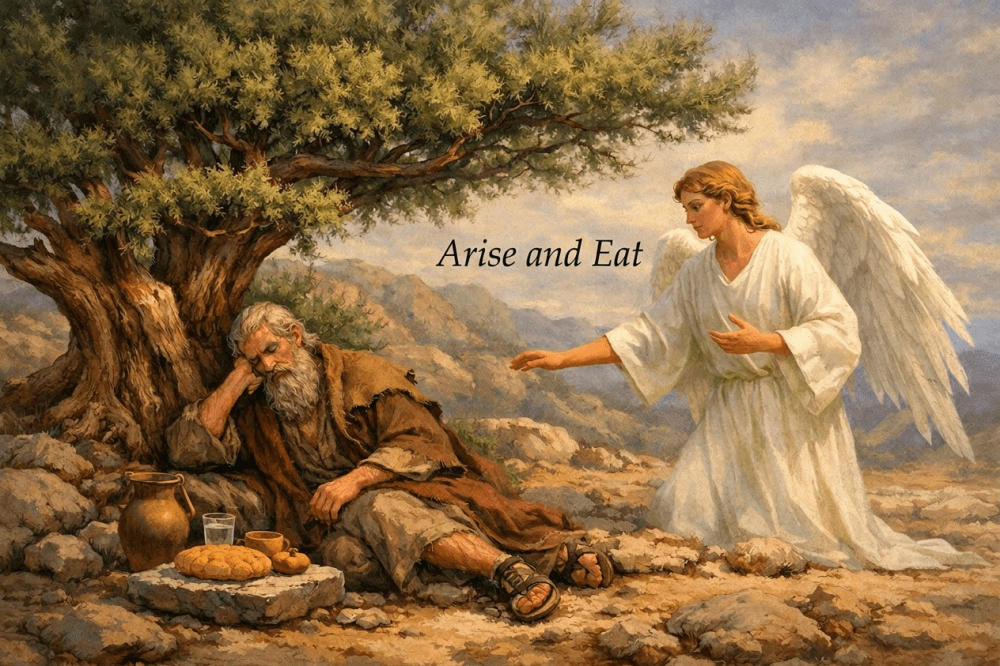
And significantly, He began not with a rebuke, but with a question.
“What are you doing here, Elijah?”
When God asks Elijah, “What are you doing here?” He invites the prophet to examine his own thoughts and motives.
Elijah responds:
“I have been very zealous for the Lord God of hosts; for the children of Israel have forsaken Your covenant, torn down Your altars, and killed Your prophets with the sword. I alone am left; and they seek to take my life” (1 Kings 19:10, NKJV).
His words reveal a heart weighed down by disappointment.
Elijah had expected Carmel to change everything. He had hoped the nation would return wholeheartedly to God. Instead, Jezebel remained defiant, and the problems seemed as overwhelming as ever.
Notice how Elijah viewed himself: “I alone am left.” Discouragement had narrowed his vision. He could no longer see the larger picture of God’s work.
The Lord’s question gave Elijah an opportunity to express his fears honestly. God was not dismissing his pain. He was drawing it into the light.
Having allowed Elijah to speak, God then prepared to teach him something essential about the nature of His work.
God is not only in the fire

The Lord instructed Elijah to stand on the mountain before Him.
Then a powerful wind tore through the rocks.
After the wind came an earthquake.
After the earthquake came a fire.
These manifestations would have reminded Elijah of dramatic displays of divine power. Yet Scripture repeatedly emphasizes:
“Then He said, “Go out, and stand on the mountain before the Lord.” And behold, the Lord passed by, and a great and strong wind tore into the mountains and broke the rocks in pieces before the Lord, but the Lord was not in the wind; and after the wind an earthquake, but the Lord was not in the earthquake; and after the earthquake a fire, but the Lord was not in the fire...” (1 Kings 19:11–12, NKJV).
Then came something unexpected:
“...and after the fire a still small voice” (1 Kings 19:12, NKJV)
The lesson was profound.
Elijah had just witnessed fire from heaven on Carmel. He may have expected God to continue working through spectacular demonstrations of power. But God wanted His servant to understand that His work is often accomplished quietly, patiently, and invisibly.
Ellen White beautifully captures this truth:
“Not in mighty manifestations of divine power, but by ‘a still small voice,” did God choose to reveal Himself to His servant. He desired to teach Elijah that it is not always the work that makes the greatest demonstration that is most successful in accomplishing His purpose.”
— Prophets and Kings, p. 168
God’s purposes are not limited to dramatic moments. Often, He works through quiet influences, patient faithfulness, and the gentle impressions of His Spirit.
The prophet needed to learn that the apparent absence of visible results did not mean God had ceased to work.
This lesson prepared Elijah for the question that would come again.
The question asked twice
After Elijah heard the still small voice, the Lord repeated the same question:
“What are you doing here, Elijah?” (1 Kings 19:13)
The repetition is significant.
God was giving Elijah an opportunity to reconsider his perspective in light of what he had just experienced.
Interestingly, Elijah’s answer remains largely unchanged. He repeats the same concerns and frustrations. Yet God’s response reveals that the prophet’s understanding is incomplete.
Elijah believed he stood alone. God informed him that there were still seven thousand in Israel who had not bowed to Baal (1 Kings 19:18).
Elijah believed his work was finished. God gave him new assignments.
Elijah believed the future was bleak. God showed him that His plans were still moving forward.
The repeated question was not intended to condemn Elijah. It was intended to lift his eyes beyond his discouragement and help him see God’s larger work.
The cave was never meant to become Elijah’s permanent dwelling place.
Conclusion
God’s question to Elijah still speaks to weary hearts today:
“What are you doing here?”
Sometimes we find ourselves in caves of disappointment, fear, loneliness, or spiritual exhaustion. A setback, a loss, an unanswered prayer, or a difficult season can leave us feeling isolated and discouraged.
Like Elijah, we may begin to believe that we are alone. We may assume that God’s purposes have failed or that our efforts have accomplished little.
Yet God comes near, not always through dramatic interventions, but often through the quiet ministry of His presence.
His question invites reflection:
- How did I arrive at this place?
- Have fear and disappointment distorted my perspective?
- Am I listening for God’s voice, or only looking for dramatic signs?
- Have I forgotten that God is still at work, even when I cannot see it?
The Lord did not leave Elijah in the cave. He met him there, spoke to him there, and then called him forward.
The same God who spoke through the still small voice continues to seek out discouraged hearts today.
And His question remains as searching and as gracious as ever:
“What are you doing here, Elijah?”


