Think about how you handle a stressful day. Maybe you reach for something sweet, pour a cup of tea and go quiet or even go on a hunger strike. Now ask yourself, where did that response come from?
Chances are, you learned it from someone.
Many of the habits we are most frustrated with, the ones that feel impossible to break, were not ones we sat down and chose. They were handed to us. They came wrapped in the family meals we grew up around, the coping patterns of the people closest to us, and the unspoken rules of the communities we belonged to. We absorbed them before we knew what we were absorbing.
In this article, we are going to look at:
- The home was your first classroom
- Your community shaped you more than you realize
- Breaking a habit that was never yours
- Grace for what you did not choose
- How to begin rewriting your story
- This week
- Your story is not finished
Let’s begin by looking at home as your very first classroom.
The home was your first classroom
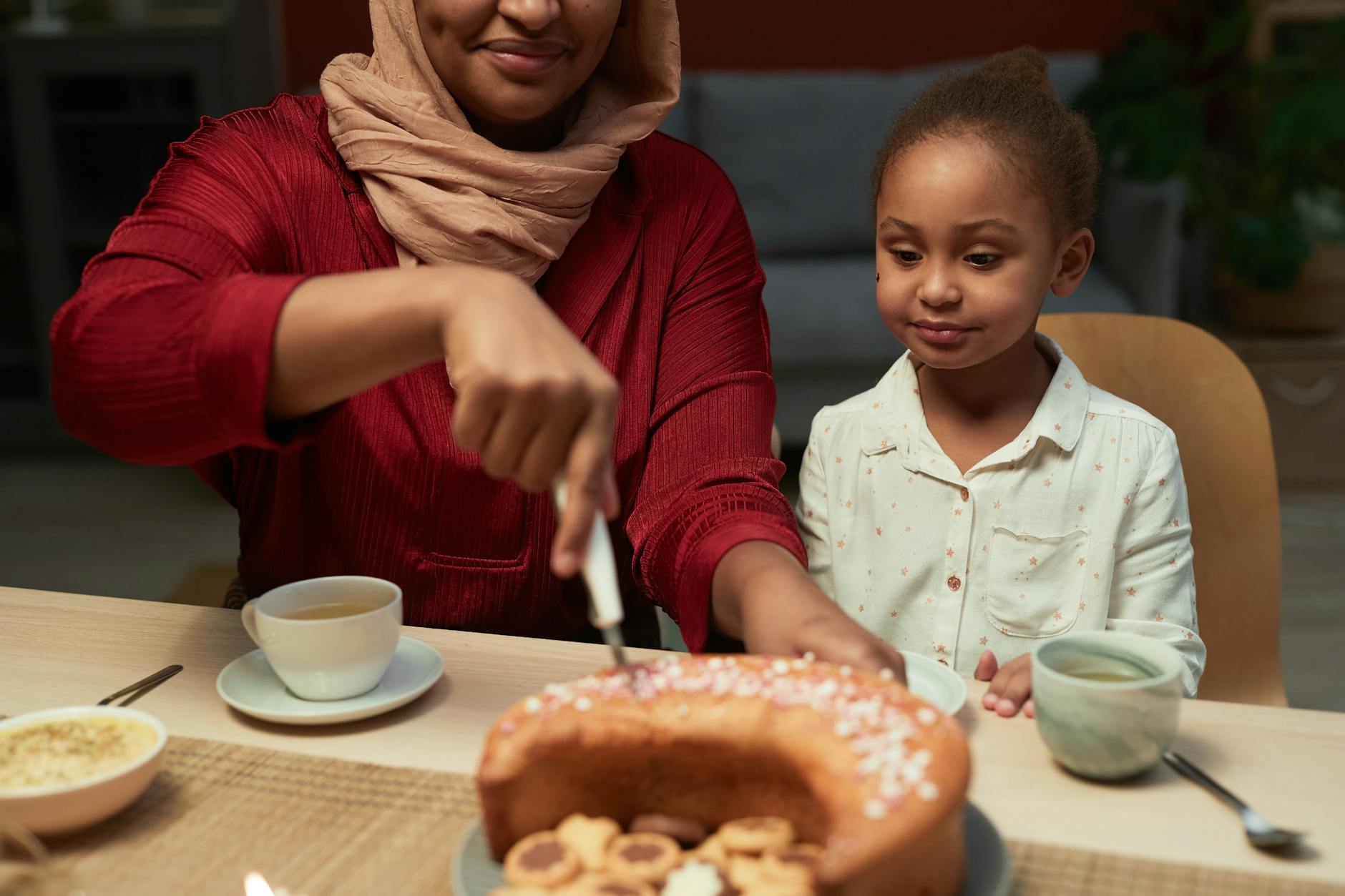
Research confirms what many of us sense to be true. Parental dietary habits and practices are among the strongest predictors of what children eat, how they eat, and how they relate to food well into adulthood. [1]
From the pace of mealtimes to whether food was used as comfort or punishment, the home environment shapes eating behavior at a level so early that most people cannot even trace it.
Think about what food meant in your home growing up. Was a finished plate a sign of love? Was dessert a reward for good behavior? Was eating the thing everyone did together at the table, or was it something you grabbed in passing? Each of those patterns left a mark.
A comprehensive review of childhood nutrition studies found that family meals are among the most significant points of influence in forming a child’s long-term dietary habits.[ 2] Not because of the food on the table alone, but because of the relationships around it.
The Bible says:
“Train up a child in the way he should go, and when he is old he will not depart from it” (Proverbs 22:6, NIV).
Most of us read that verse in the context of faith and character. But the body is not exempt from the principle. Whatever a child is trained toward, in terms of rest, food, movement, stress, and care, tends to follow them.
Your community shaped you more than you realize

The influence does not stop at the front door.
A landmark study published in the New England Journal of Medicine followed over 12,000 people across 32 years as part of the Framingham Heart Study. The researchers found that when a person’s close friend became obese, that individual’s own risk of becoming obese increased by 57 percent.[ 3] The same pattern appeared with siblings and spouses.
The researchers were clear: it was not simply that people with similar lifestyles chose each other as friends. The data showed that the habits genuinely spread through relationships. What we normalize among the people closest to us becomes what we practice ourselves, often without noticing.
This is not an accusation toward anyone we love. It is simply the way human beings are wired. We are deeply social creatures. We calibrate ourselves to the people around us. We pick up their rhythms, their language, their appetites, and their coping strategies the same way we pick up an accent after living somewhere long enough.
1 Corinthians 15:33 puts it plainly: “Do not be deceived: bad company corrupts good morals” (NIV). That verse is usually quoted in the context of moral failure. But its truth runs through the body as well. The company we keep shapes the choices we make, including the ones we make with our health.
Breaking a habit that was never yours
The hardest part of breaking an inherited habit is that it does not feel like a habit. It feels like who you are. If everyone in your family skipped breakfast and pushed through the morning on caffeine, then doing that feels normal. If everyone in your community ate late, ate heavy, and never spoke about rest as a form of stewardship, then doing the same feels like belonging.
This is why willpower alone does not work. You are not just fighting a behavior. You are navigating an identity, a sense of belonging, and sometimes an unspoken loyalty to the people who raised you.
But here is the truth that scripture speaks into this moment. Transformation does not begin with a better routine. It begins with a renewed mind.
Romans 12:2 says: “Do not be conformed to this world, but be transformed by the renewing of your mind, so that you may discern what is the will of God, what is good and acceptable and perfect” (NIV)
The word transformed in the original Greek is metamorphoo. The same word we get metamorphosis from. It is not a slight adjustment. It is a full and deep change, from the inside out.
God is not asking you to fix what you inherited on your own. He is inviting you into a process that starts with His truth, not with your effort.
Grace for what you did not choose
Before we talk about what to change, it is worth taking a moment to sit with something important. You are not to blame for what was modeled to you before you had a choice.
Ellen G. White writes::
“God’s word places great stress upon the influence of association, even upon men and women. How much greater is its power on the developing mind and character of children and youth. The company they keep, the principles they adopt, the habits they form, will decide the question of their usefulness here and of their future, eternal interest.” [ 4 ]–The Ministry of Healing pg.402.3
She was not writing that to assign guilt but to help us understand why change can feel so difficult, and why it requires more than surface-level effort.
Many people carry deep shame around their health habits without understanding that those habits have roots. When you understand the roots, you stop treating the symptoms with condemnation and start treating them with something closer to compassion and truth.
Grace does not excuse a pattern. But it does give you a starting point that is not shame.
How to begin rewriting your story

Rewriting an inherited health story is slow work. It does not happen in a seven-day cleanse or a month of new routines. But it does happen. And it begins with a few honest, grounded steps.
- Name what you received. Spend time reflecting on the habits you grew up with. What was the relationship with food in your home? How did the people around you handle stress, tiredness, or illness? You cannot change what you have not named.,
- Take it to God before you take it to a plan. Ask Him to show you which patterns serve your body well and which ones do not belong in the life He is building with you. This is a spiritual conversation as much as a practical one.
- Choose your community with intention. If your current relationships are reinforcing patterns you want to leave behind, you do not have to abandon those people. But you may need to seek out additional community where different norms are being lived out. Healthy habits spread the same way unhealthy ones do.
- Change one small thing and let it stand. You do not need a complete overhaul. Choose one pattern you want to shift. Eat breakfast. Sleep before midnight. Take a walk without your phone. Let that one thing take root before you add another. Small obedience practiced consistently becomes character.
- Give your body the benefit of a longer story. You did not inherit these habits overnight. You will not replace them overnight. Be patient with yourself the way God is patient with you.
This week
Sit with this question sometime today: what health habit do I have that I never consciously chose? Just one. Write it down if you can.
Then ask: Who modeled this to me? And then, the most important question: is this something I want to pass on?
Because you are not just rewriting your own story. The people around you are watching. Your children, your friends, your community. The habits you break and the ones you build will reach further than you know.
Your story is not finished
You came into this world shaped by people who were themselves shaped by people before them. That is not a curse. It is the human condition. And it is exactly the territory into which God speaks.
He does not look at what was handed to you and call it final. He looks at what is handed to you and calls it material for His work.
Jeremiah 29:11 is a verse often quoted in moments of purpose and direction. But read it in the context of the body: “For I know the plans I have for you, declares the Lord, plans for welfare and not for calamity, to give you a future and a hope” (NIV).
The body you live in is part of that future. And the story being written in it is not over.
Begin somewhere. God will meet you there.
Citations
1. Rossi MF et al. The Influence of Parental Dietary Behaviors and Practices on Children’s Eating Habits. Nutrients. 2021;13(4):1138.
2. Christakis NA, Fowler JH. The spread of obesity in a large social network over 32 years. N Engl J Med. 2007;357(4):370-379.
3. Birch LL, Davison KK. Parental influence on eating behavior: conception to adolescence. J Law Med Ethics. 2007;35(1):22-34.
4. White EG. The Ministry of Healing. Pacific Press Publishing Association; 1905:354.


One thought on “Habits You Never Chose: How Relationships Wrote Your Health Story”