
Food brings people together. Could be a birthday cake, a social lunch, a holiday spread, or even a family dinner. There is something special and holy about sharing a meal. But somewhere between the first serving and the third helping, the line between feasting and gluttony starts to blur. And most of us do not even notice when we cross it.

The Bible does not tell us that food is bad. We even see Jesus Himself sharing a meal with his disciples many times and even feeding a hungry crowd. It tells us to be honest about our relationship with it. That’s why,
In this article, we are going to explore:
- God created feasting on purpose
- So, what is gluttony, really?
- The Real difference between the two
- What Your Body Is Actually Telling You
- How to feast well
- Little assignment
- The table is still a holy place
Let’s start with the foundation—understanding the basics of God’s design.
God created feasting on purpose
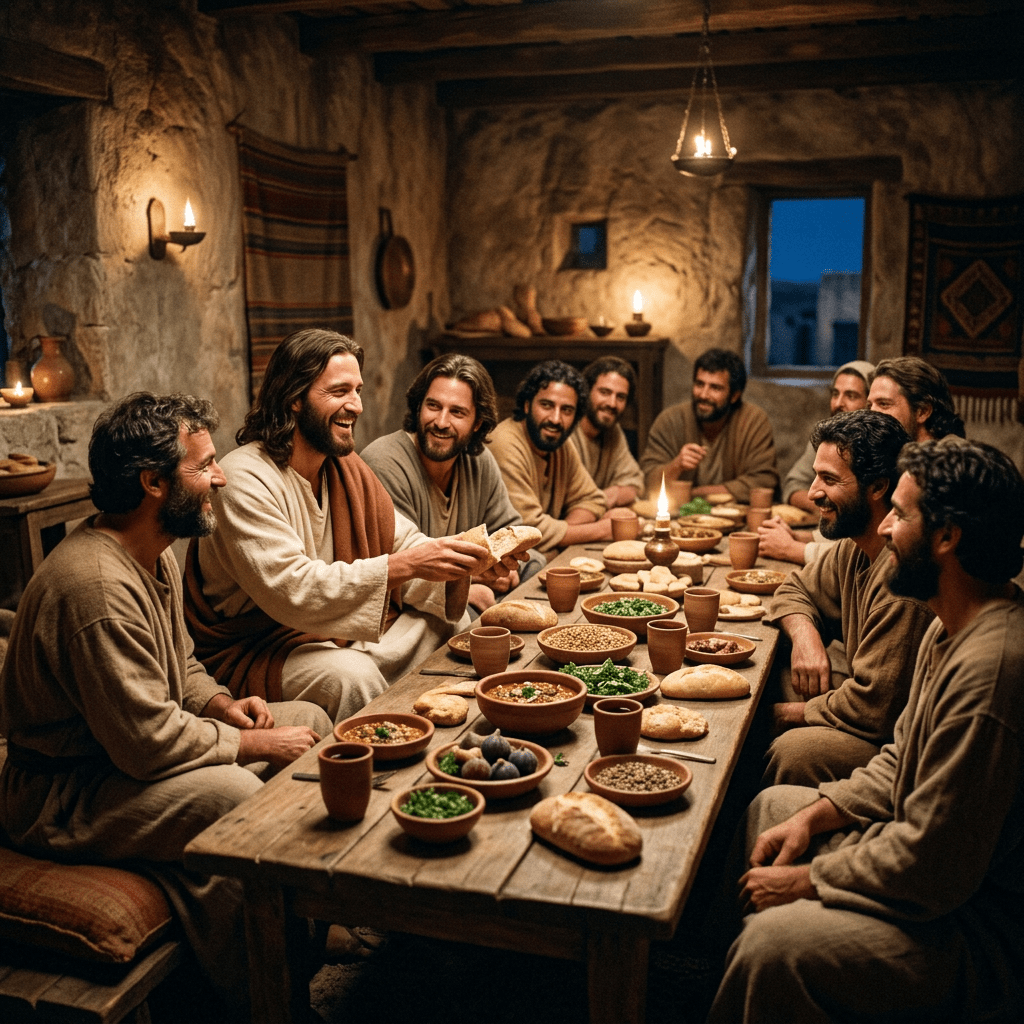
Feasting is a biblical concept.
Scripture records over a dozen major feasts that God Himself ordained. Passover, Pentecost, and the Feast of Tabernacles. These were not modest snack-and-go occasions. They were multi-day celebrations filled with music, community, and abundant food.
Nehemiah 8:10 says it plainly: “Go and enjoy choice food and sweet drinks, and send some to those who have nothing prepared” (NIV). This was not permission reluctantly granted. It was a command. Enjoyment was woven right into worship.
In the New Testament, Jesus performed His first miracle at a wedding feast. He turned water into wine so the celebration would not fall short. He did not subtract from the joy of the occasion. He added to it.
Feasting, at its core, is gratitude made physical. It is the body participating in thankfulness.
So, what is gluttony, really?
Gluttony is not simply eating a lot. If that were true, every camp meeting table would be a spiritual problem. Gluttony is about the posture of the heart, not the size of the plate.
Proverbs 23:20-21 warns “not to join those who drink too much wine or gorge themselves on meat, for drunkards and gluttons become poor, and drowsiness clothes them in rags” (NIV). The warning is about what eating without restraint does to a person over time, physically, financially, and spiritually.
Gluttony is food functioning as a substitute. A substitute for comfort, for control, for the peace that only God provides. It is the pattern of reaching for the refrigerator when you feel anxious, bored, or empty. It happens so consistently that food becomes a coping mechanism rather than a source of nourishment.
Philippians 3:19 describes those “whose god is their stomach” (NIV). That phrase is not about people who enjoy food. It describes individuals whose appetite has become the dominant force in their lives. But then, where do we draw the line?
The Real difference between the two
I would like to consider feasting intentionally. Here is why. It is bounded by occasion, community, and gratitude. You are present at the table. You know why you are eating. You stop when the celebration ends.
On the other hand, gluttony is compulsive. It does not need an occasion. It is eating to escape rather than to celebrate. It is the fourth bowl of cereal at midnight, not because you are hungry, but because something feels off and you do not know what else to do with that feeling. Does that sound familiar?
A few honest questions to ask yourself:
- Am I eating to celebrate or to numb?
- Am I present at this meal or checked out?
- Would I be embarrassed if someone could see exactly how much I ate and why?
- Am I choosing this food freely, or does it feel like I cannot stop?
Those questions are not meant to guilt-trip you, dear reader. They are meant to produce clarity.
Did you know that your body can actually communicate with you?
What Your Body Is Actually Telling You

Research in health psychology consistently shows that emotional eating is one of the primary drivers of overconsumption. A review published in Proceedings of the Nutrition Society found that stress significantly increases caloric intake and preference for hyperpalatable foods, independent of actual hunger. [1]
The body is not broken when this happens. It is actually doing exactly what bodies do under stress, seeking fast comfort. But the body was not designed to carry the full weight of emotional regulation on its own. That is the work of the Spirit.
1 Corinthians 6:19-20 reminds us that the body is a temple of the Holy Spirit. Ellen G. White writes in The Ministry of Healing, p. 235: “Our bodies are not our own. They are the property of God.” Stewardship of the body includes being honest about what we are feeding it and why we are feeding it.
When overeating becomes a pattern, the body pays the price. Chronic overconsumption is linked to inflammation, metabolic dysfunction, poor sleep, and mood instability. These effects create a cycle that only makes the emotional pull toward comfort eating grow stronger. [2]
So, how do you practically feast the right way?
How to feast well
The goal is not a rigid food rulebook but a free relationship with food. The one where you are in charge and your appetite is not.
So, how do you practically do this?
- Start with gratitude before you eat. A short prayer or a moment of acknowledgment before meals is not just a ritual. It is a reset. It repositions food as a gift rather than a default response to whatever you are carrying in that moment.
- Eat at a table when you can. Eating in front of screens, in the car, or while scrolling detaches you from the physical experience of eating. Mindful eating, which simply means being present at the meal, is associated with better satiety signals and reduced overconsumption. [3]
- Name what you are feeling before you eat. Not as an interrogation, just as honesty. Ask yourself if you are hungry, tired, stressed, or lonely. You do not need to solve the feeling right away. Naming it gives you a choice about what to do next.
- Give yourself full permission to enjoy celebrations. A feast is a feast. Eat the birthday cake without a guilt spiral afterward. Restriction and shame are not the antidote to gluttony. Freedom and awareness are.
- Build rhythms of fasting alongside feasting. Jesus fasted (Matthew 4:2) and also ate with joy at many tables. These two practices held together create a healthy, grounded relationship with food. Fasting is not punishment. It is a reminder that the body is not ultimate.
With the knowledge at hand, you can handle a little assignment, right? Let’s have a simple and practical assignment.
Little assignment
This week, try picking one meal and eating it without distraction. No phone, no screen. Just the food, the table, and whatever gratitude you can bring to it.
Before your next large meal, ask yourself whether this is a feast or whether you are feeding something else. Let the answer be honest, not condemning.
If you notice a pattern of emotional eating, bring it to God before you bring it to the kitchen. Not because the food is off limits, but because you deserve more than a temporary fix.
The table is still a holy place
Neither food nor your appetite was ever the enemy. The question the Bible invites you to sit with is not whether you enjoy eating but who or what you are eating for.
A feast shared with gratitude and presence is an act of worship. A meal eaten in secret to quiet pain is a signal worth paying attention to.
The table is still a holy place. Sit at it like you believe that.
Citations
- Sinha, R., & Jastreboff, A. M. (2013). Stress and eating behaviors. Proceedings of the Nutrition Society, 72(3), 387–392. https://pubmed.ncbi.nlm.nih.gov/24126546/
- Koopman, M., Lötter, T., Warmelink, J., Bast, N., & Jansen, A. (2024). Emotional eating and obesity in adults: The role of depression, sleep and genes. Proceedings of the Nutrition Society, 79(3), 283–294. https://www.cambridge.org/core/journals/proceedings-of-the-nutrition-society/article/emotional-eating-and-obesity-in-adults-the-role-of-depression-sleep-and-genes/C69DF0C844DFF0DD87E99ECFA7B50D98
- Warren JM, Smith N, Ashwell M. A structured literature review on the role of mindfulness, mindful eating and intuitive eating in changing eating behaviours: effectiveness and associated potential mechanisms. Nutrition Research Reviews. 2017;30(2):272-283. doi:10.1017/S0954422417000154 https://www.cambridge.org/core/journals/nutrition-research-reviews/article/structured-literature-review-on-the-role-of-mindfulness-mindful-eating-and-intuitive-eating-in-changing-eating-behaviours-effectiveness-and-associated-potential-mechanisms/351A3D01E43F49CC9794756BC950EFFC