Is there something you know you were made to do that you have been putting off? A gift you have been sitting on, waiting for a better season, more confidence, more money, more permission?
Have you told yourself you are being humble, being realistic, being responsible, while quietly, the thing God placed in you stays buried, patient, and growing heavier every year?
We talk a great deal in the church about the sins that are visible: pride, immorality, and dishonesty. But there is a sin that looks nothing like sin from the outside. It looks like caution. It looks like waiting on God. It looks like not wanting to get ahead of yourself. And Jesus named it plainly in one of the most uncomfortable parables He ever told.
We’ll cover:
Let us go to the parable, because the servant who buried his gift is more familiar than most of us would like to admit.
The man who buried his talent and called it wisdom
In Matthew 25:14-30, Jesus tells the story of a master who entrusts his servants with significant sums of money before travelling. One receives five talents, another two, and another one.
A talent was worth roughly twenty years of a day labourer's wages, not a small thing. This was not a test of what they did with spare change. This was a test of what they did with something of real weight and value.
The servant with five talents put his to work and doubled them. The servant with two did the same. But the servant with one talent dug a hole and buried it. And when the master returned and asked for an account, this servant had a perfectly reasonable explanation ready: he said he knew the master was a hard man, that he was afraid, and so he played it safe. Here is what is yours, he said. I kept it intact. I did not lose it. I did not waste it.
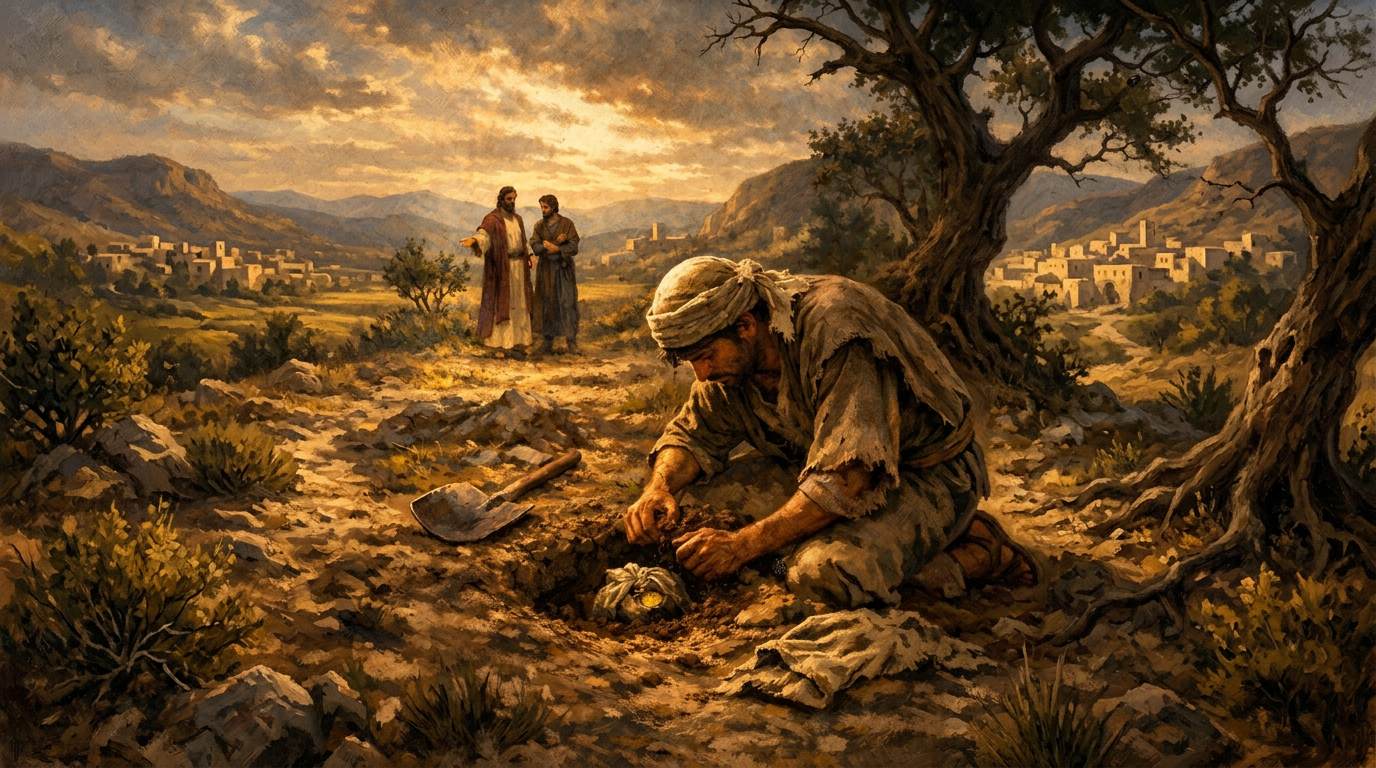
He expected approval. He received the harshest response in the parable.
"You wicked and lazy servant! So you knew that I harvest where I have not sown and gather where I have not scattered seed? Well then, you should have put my money on deposit with the bankers, so that when I returned I would have received it back with interest" (Matthew 25:26-27, NIV).
The master did not call him cautious. He called him wicked. He did not call him humble. He called him lazy. The language is jarring because we have been conditioned to see burying as safe. Jesus says burying is failure. The gift that goes unused is not protected. It is wasted.
But it is the reason the servant gives that deserves the most attention. Because it is the same reason most of us give.
What the master’s anger actually tells us
The servant said, “I was afraid.”
That is the root of it. Not rebellion, not indifference, not contempt for the master. Fear. The fear of getting it wrong. The fear of trying and failing. The fear of what it would cost to put yourself out there and come back with less than you started with.
Fear is one of the most effective burial tools available. It does not feel like disobedience. It feels like wisdom. It tells you to wait until the timing is right, until you are more prepared, until you have more to work with, until the risks are smaller. And the years pass. And the gift stays in the ground. And the master returns.
What the master's anger reveals is that God does not regard the squandering and the burying of a gift as fundamentally different outcomes. Both result in the gift going unused. Both result in the master's investment returning nothing.
The difference between the servant who gambled and lost and the servant who buried and kept is that one at least tried. Jesus’ words strongly suggest that He would have preferred the attempt to the paralysis.
Proverbs 29:25 puts it plainly: the fear of man is a snare. It traps. It immobilises. It produces exactly the outcome it was trying to avoid, a life lived smaller than it was designed to be. And the fear of failure, which is really the fear of what others will think if you try and fall short, is the same snare in a different frame.
But fear rarely shows up and announces itself. It prefers disguise.
The disguises small ambition wears
Small ambition does not usually say, “I am afraid.” It says things that sound much more spiritual. It says, “I am waiting on God’s timing.” It says, “I do not want to get ahead of myself.” It says, “Who am I to think I could do something like that?” It says, “I will start when the conditions are better, when I have more experience, when I feel more ready.”
Waiting on God’s timing is real and necessary. But there is a version of it that is simply procrastination wearing a prayer cloth. The servant in the parable did not say he was actively disobeying. He was waiting. He was holding. He was being careful. And Jesus called it wickedness, because the waiting was not faith. It was fear dressed as faithfulness.
False humility is another disguise. Saying I am not talented enough, not qualified enough, or not ready can sound like deference to God. But God knows what He placed in you. He gave the talents according to the servant’s ability, the text says. He knew what each person could handle. Telling Him you are not capable is not humility. It disagrees with His assessment of you.
Comparison is a third disguise. Looking at the servant with five talents and deciding that, because you only have one, your contribution does not matter enough to try. But the master did not give all three servants the same amount and then grade them against each other. The servant with two was praised equally with the servant with five. The measure was not the size of the gift. It was the faithfulness with which it was used.
Which brings us to what faithfulness with little actually looks like in real life.
What faithfulness with little actually looks like
The parable does not say the servants had to produce dramatic results in glamorous ways. It says they put what they had to work. That is the whole of it. They took what was given, they moved with it, and the movement itself was the faithfulness.

Luke 16:10 adds a layer that the Matthew parable implies: whoever can be trusted with very little can also be trusted with much.
The path to more is not waiting until you have more. It is being faithful with what is in your hands right now.
The classroom you teach in. The small platform you have. The idea you keep dismissing as not significant enough. The skill you have been practicing privately and telling yourself is not ready to show anyone.
The master in the parable did not ask the servants to do something they had not been equipped for. He gave each one according to their ability. That means when God gives you a gift, He has already done the calculation. He knows your capacity. He is not setting you up to fail. He is giving you something real to work with and watching to see whether fear or faith will determine what you do with it.
Ecclesiastes 9:10 says whatever your hand finds to do, do it with all your might. Not when the conditions are perfect. Not when the fear has fully lifted. Not when you feel ready. With all your might, with what your hand finds to do, now.
The servant who buried his talent was not punished for having one talent. He was punished for doing nothing with it. The sin was not smallness. The sin was stillness.
So what does beginning to move actually look like this week?
This Week
- Name what is buried. Write it down. The gift, the idea, the calling, the thing you keep thinking about and keep not starting. Naming it is the first act of taking it seriously.
- Identify the fear beneath the waiting. What exactly are you afraid will happen if you try? Being specific about the fear takes away some of its power. Vague fear controls. Named fear can be prayed over.
- Do one small thing this week with what you have. Not the whole vision. One step. Write the first paragraph. Make the call. Send the message. Post the thing. The master praised the servants who moved, not the ones who waited for perfect conditions.
- Stop waiting to feel ready. Readiness is rarely a feeling that arrives before you begin. It is usually something you discover mid-step. The servants in the parable did not wait to feel confident. They went and traded.
- Bring it back to stewardship, not performance. The gift is not yours to protect. It belongs to the master. Your job is not to safeguard it from risk. Your job is to put it to work for the kingdom it came from.
Bottomline
The servant with one talent was not condemned for having less than the others. He was condemned for treating what he had as something too small to bother with. For deciding that the safest thing was to keep it hidden, to wait, to hold on until the master came back, and to hand it back exactly as he received it.
God did not place what He placed in you for you to keep safe. He placed it there because there is work it was meant to do, people it was meant to reach, a kingdom it was meant to build. And every year it stays buried is a year the master’s investment sits idle, earning nothing.
Playing it safe with your gifts is not humility. It is not wisdom. It is not waiting on God. It is the sin the parable was written to expose. And the good news is that the master has not yet returned. The ground can still be dug up. The talent can still be put to work. It is not too late to begin.
“Well done, good and faithful servant! You have been faithful with a few things; I will put you in charge of many things. Come and share your master's happiness!”(Matthew 25:23, NIV).
Do you want to learn more about taking a bold step with what God has deposited in your life?
Go to the Personal Growth section of The Cleaver to find practical articles on how you can better at what you should be better at.
Start with these choice reads:
- The Difference Between Waiting on God and Postponing Life’s Decisions out of fear or indecision – Learn how to discern active faith from fear-driven hesitation and overcome the paralysis of overthinking.
- Consistency: Why You Need It and 5 Practical Ways to Build It – Discover practical strategies to maintain steady progress and build habits that stick over the long haul.
- Discipline and Success: Why You Can’t Build a Better Life Without It – Understand the foundational role self-discipline plays in achieving your personal goals and unlocking long-term success.


