“And you shall make no covenant with the inhabitants of this land; you shall tear down their altars.’ But you have not obeyed My voice. Why have you done this?” (Judges 2:2, NKJV).
Context
The book of Judges begins in the shadow of a great transition. Joshua—the faithful leader who had guided Israel into the Promised Land—has died. The generation that witnessed God’s mighty works in the conquest of Canaan is gradually passing away. A new generation rises, one that did not experience the miracles of the wilderness or the dramatic victories of Jericho and Ai firsthand.
At first, Israel continues the work of settling the land. But slowly, almost imperceptibly, something begins to change. The people no longer drive out the inhabitants of the land as completely as God had commanded. Instead, they begin to live among them.
What begins as coexistence soon becomes compromise.
In response, the Angel of the Lord appears at a place that would soon be called Bochim, meaning “weepers.” There, He reminds the people of God’s covenant faithfulness—how He brought them out of Egypt and led them into the land He had promised.
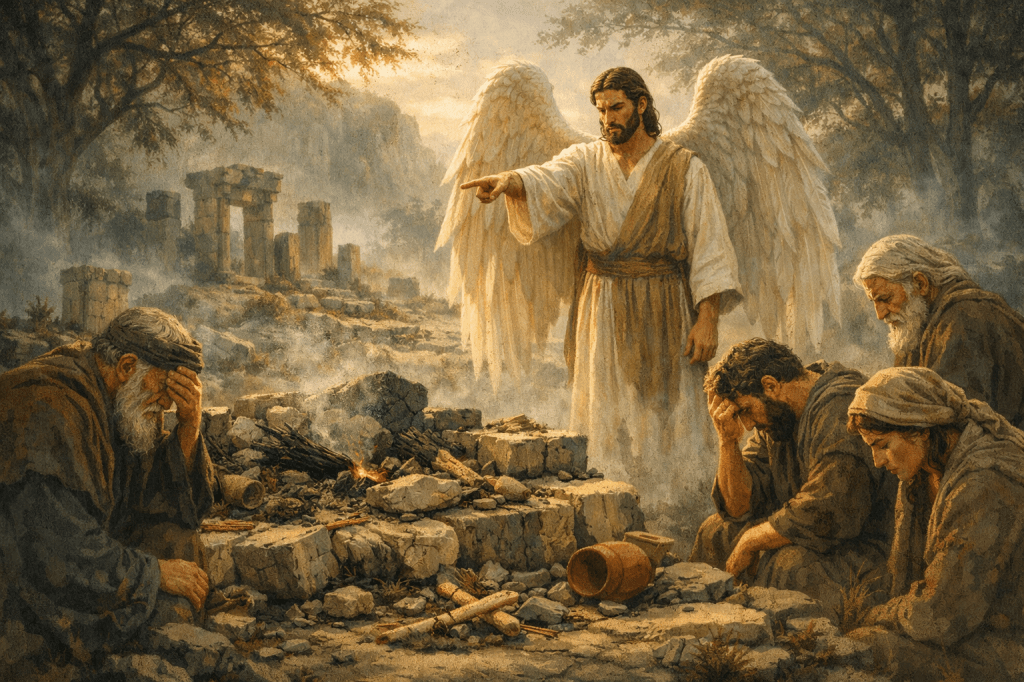
Then comes a solemn rebuke, “You have not obeyed My voice.”
And with it, a searching question that echoes across generations, “Why have you done this?” This question is crucial and leads to self-reflection.
To expose Israel’s compromise and tensions with loyalty to God in the promised land, we’ll cover:
- Context
- The forgotten command
- When compromise becomes disobedience
- “Why have you done this?”
- The cost of ignoring God’s voice
- Conclusion
Let’s kick it off with the forgotten commands.
The forgotten command
God had spoken clearly to Israel long before they entered the land. They were not to make covenants with the inhabitants of Canaan, nor were they to allow the altars of foreign gods to remain standing.
God’s command was clear, “You shall tear down their altars” (Judges 2:2).
This command was not given out of cruelty or cultural hostility. It was given for protection. The idolatry of the surrounding nations was deeply corrupting, tied to practices that would slowly erode Israel’s devotion to the Lord.
God understood what His people sometimes failed to see: what we tolerate today often becomes what we follow tomorrow.
Yet Israel gradually relaxed its obedience. Instead of removing the altars, they allowed them to remain. Instead of separating from the idolatrous culture around them, they learned to live with it.
And as God had been faithful with His promises, He would equally be faithful with His threatenings, as well described in Ellen white’s reflection of Joshua’s final address to the Israelites:
“Joshua appealed to the people themselves as witnesses that, so far as they had complied with the conditions, God had faithfully fulfilled His promises to them. “Ye know in all your hearts and in all your souls,” he said, “that not one thing hath failed of all the good things which the Lord your God spake concerning you; all are come to pass unto you, and not one thing hath failed thereof.” He declared to them that as the Lord had fulfilled His promises, so He would fulfil His threatenings. “It shall come to pass, that as all good things are come upon you, which the Lord your God promised you; so shall the Lord bring upon you all evil things…. When ye have transgressed the covenant of the Lord, … then shall the anger of the Lord be kindled against you, and ye shall perish quickly from off the good land which He hath given unto you.” —Patriarchs and Prophets, p. 522.1 (Ellen Gould White)
And so the command that had once been clear slowly faded into the background.
And in most cases, what starts as a compromise soon becomes outright disobedience. Let’s see about it next.
When compromise becomes disobedience
At first glance, Israel’s actions might not have seemed like open rebellion. The people were still living in the land God had given them. They still knew His name. They had not formally renounced their faith.
But compromise often works quietly. It begins with small accommodations that appear harmless or convenient.
The nations that were meant to be removed became neighbours. Their customs became familiar. Their religious practices, once clearly forbidden, gradually lost their sense of danger.
What began as coexistence soon became disobedience. It is at this point that God confronts His people directly.
“Why have you done this?”
God’s question in Judges 2:2 is striking in its simplicity: “Why have you done this?”
This is not a question asked because God lacks information. He already knows what Israel has done. Instead, the question invites the people to confront the reality of their own choices.
God reminds them of His faithfulness:
“I led you up from Egypt and brought you to the land of which I swore to your fathers; and I said, ‘I will never break My covenant with you” (Judges 2:1, NKJV).
He had kept every promise. He had fulfilled His covenant. The failure lay not with God, but with His people.
Ellen White describes the moment with solemn clarity:
“The Lord had faithfully fulfilled, on His part, the promises made to Israel; Joshua had broken the power of the Canaanites, and had distributed the land to the tribes. It only remained for them, trusting in the assurance of divine aid, to complete the work of dispossessing the inhabitants of the land. But this they failed to do. By entering into league with the Canaanites, they directly transgressed the command of God, and thus failed to fulfill the condition on which He had promised to place them in possession of Canaan.”
—Patriarchs and Prophets, p. 543 (Ellen Gould White)
God’s question, therefore, exposes more than a mistake. It reveals a broken relationship of trust and obedience.
And such steps are costly to individuals, to families, and to nations. Let’s understand why next.
The cost of ignoring God’s voice
Because Israel chose compromise, God declares that the consequences will remain:
“Therefore I also said, ‘I will not drive them out before you; but they shall be thorns in your side, and their gods shall be a snare to you’” (Judges 2:3, NKJV)
The very influences Israel tolerated would become the source of their future struggles. This verse introduces the tragic cycle that dominates the rest of the book of Judges:
- Israel compromises and turns from God
- Oppression follows
- The people cry out for deliverance
- God raises a judge to rescue them
- The cycle begins again
All of it can be traced back to the moment when God asked, “Why have you done this?”
What might have seemed like small concessions became the seeds of national decline. As Ellen White writes:
“The Israelites fixed their hopes upon worldly greatness. From the time of their entrance to the land of Canaan, they departed from the commandments of God, and followed the ways of the heathen. It was in vain that God sent them warning by His prophets. In vain they suffered the chastisement of heathen oppression. Every reformation was followed by deeper apostasy.” —The Desire of Ages, p. 28.1 (Ellen Gould White)
Conclusion
God’s question at Bochim still speaks with quiet urgency: “Why have you done this?”
It invites us to examine the subtle compromises that can enter our own lives. Rarely do people abandon their convictions all at once. More often, it begins with small choices—tolerating what we once resisted, excusing what we once recognised as harmful, allowing influences to remain that slowly reshape our hearts.
The Israelites wept when they heard God’s words, and the place where they gathered became known as Bochim, meaning “the place of weeping.”
But tears alone cannot undo disobedience. What God ultimately seeks is not only sorrow for wrong, but renewed obedience to His voice.
The question remains as relevant today as it was in ancient Israel:
- Why do we hold on to what God has told us to remove?
- Why do we compromise with influences that weaken our faith?
- Why do we drift from the clarity of God’s commands?
God’s question is not merely a rebuke. It is an invitation to return. For the God who confronts His people with truth is the same God who calls them back to covenant faithfulness.
And it all begins with a question: “Why have you done this?”

 The Cleaver