In our last article, The Rich Man and Lazarus, we saw that Jesus’ story functions as a parable. One that calls us to listen to Scripture and respond to God in this life, rather than offering a literal map of the afterlife.
Yet one question still lingers for many readers:
When the Bible speaks of “eternal punishment,” does it mean a punishment that never ends, or a punishment whose result is final?
To answer that, we need to look carefully at how Scripture uses the word eternal. We’ll cover:
- What does “eternal” describe?
- When “eternal” refers to results
- Eternal Life vs Eternal Death
- Fire that cannot be reversed
- Justice that ends evil
- Why this matters
- The gift at the centre
- Looking ahead
Let’s start by understanding what the word ‘eternal’ describes.
What does “eternal” describe?
The phrase comes directly from Jesus’ words:
“And these will go away into everlasting punishment, but the righteous into eternal life” (Matthew 25:46, NKJV).
At first glance, the parallel suggests equal duration. Eternal life lasts forever, so eternal punishment must also last forever.
But notice something important: the verse pairs eternal life with everlasting punishment, not with eternal punishing.
That distinction matters.
- Eternal life is an ongoing experience
- Everlasting punishment can describe a completed act with lasting results
In other words, the focus may not be on the process, but on the outcome.
Let’s see examples of where eternal or everlasting means results and not necessarily duration.
When “eternal” refers to results
The Bible often uses “eternal” (or “everlasting”) to describe the lasting effect of something, not its duration as an ongoing activity.
Consider these examples:
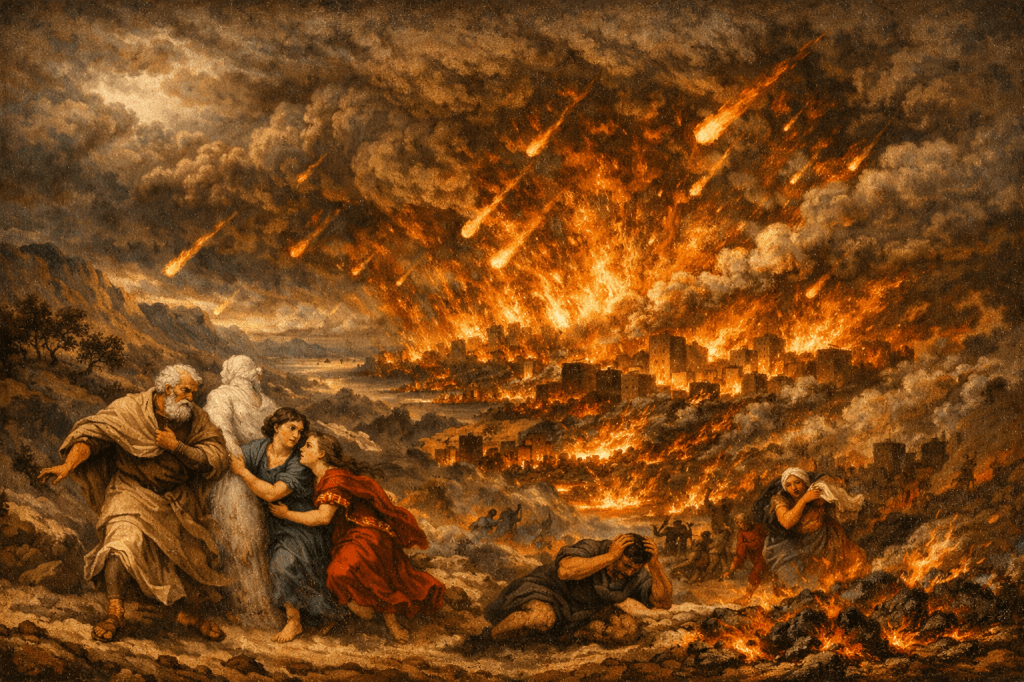
“as Sodom and Gomorrah, and the cities around them in a similar manner to these, having given themselves over to sexual immorality and gone after strange flesh, are set forth as an example, suffering the vengeance of eternal fire” (Jude 7, NKJV).
Sodom and Gomorrah are not still burning today. Yet the fire is called eternal.
Why?
Because its result was permanent. The destruction was complete and irreversible.
The same pattern appears elsewhere:
“These shall be punished with everlasting destruction from the presence of the Lord and from the glory of His power” (2 Thessalonians 1:9, NKJV).
Destruction is not something that continues forever as a process. It is something that reaches completion.
So how does eternal life compare with eternal death?
Eternal Life vs Eternal Death
Throughout Scripture, the final contrast is consistent:
- Life vs death
- Salvation vs destruction
- Restoration vs perishing
Jesus says:
“For God so loved the world that He gave His only begotten Son, that whoever believes in Him should not perish but have everlasting life” (John 3:16, NKJV).
Paul echoes the same idea:
“For the wages of sin is death, but the gift of God is eternal life in Christ Jesus our Lord” (Romans 6:23, NKJV).
The Bible does not present two kinds of eternal life: one joyful and one miserable. It presents eternal life as a gift, and death as its opposite.
When placed alongside this consistent pattern, “eternal punishment” naturally reads as a punishment whose result is eternal death.
This brings us to fire that cannot be quenched.
Fire that cannot be reversed
Scripture also uses phrases like “eternal fire” and “unquenchable fire.”
As we have already seen, these expressions describe fire that:
- Cannot be stopped
- Fully accomplishes its purpose
- Produces irreversible results
Once again, the emphasis is not on endless burning, but on finality.
When something is reduced to ashes, the process ends, but the result remains. And with this comes a final termination of evil.
Justice that ends evil
This understanding also helps make sense of the broader biblical story.
The Bible consistently points toward a future where:
“And God will wipe away every tear from their eyes; there shall be no more death, nor sorrow, nor crying. There shall be no more pain, for the former things have passed away” (Revelation 21:4, NKJV).
And again:
“What do you conspire against the Lord? He will make an utter end of it. Affliction will not rise up a second time” (Nahum 1:9, NKJV).
If suffering continues forever in some corner of the universe, then evil is never truly removed.
But if judgment results in the final destruction of sin, then the promise of a restored creation becomes coherent. Evil is not preserved. It is ended.
Why this matters
This is not simply a question about definitions. It shapes how we understand both justice and hope.
If “eternal punishment” means unending torment, then existence itself becomes divided forever between joy and suffering.
If it means a final, irreversible judgment—what Scripture calls the “second death”—then the story moves toward resolution: a world where sin is no more.
At the same time, the seriousness of the warning remains. The loss described in Scripture is not temporary. It is permanent.
Yet at the centre of all these is a gift we all can accept if we choose to.
The gift at the centre
At the heart of the Bible’s message is a simple but profound contrast:
- Death is the natural outcome of sin
- Eternal life is the gift of God
That gift is not automatic. It is given “in Christ Jesus our Lord” (Romans 6:23).
The invitation of the gospel is not merely to avoid punishment, but to receive life.
Looking ahead
With this, the main questions about death, judgment, and hell begin to come together.
But one final theme remains:
What does all of this reveal about the character of God?
Is divine judgment consistent with divine love? And how should we understand God’s justice in light of the cross?
In the next article, we will step back and consider the bigger picture: hell, justice, and the character of God.
This article is part of an ongoing series exploring death, resurrection, judgment, and hope—by reading Scripture carefully and allowing its language to define its own meaning.

 The Cleaver