
“So the Lord said to Joshua: “Get up! Why do you lie thus on your face?” (Joshua 7:10, NKJV).
Context
The book of Joshua opens with remarkable momentum. After years of wandering in the wilderness, Israel has finally crossed the Jordan River and entered the land God promised to their ancestors. Their first great challenge—the fortified city of Jericho—falls in a way no military strategist could have predicted. At God’s command, the people march around the city, the priests blow their trumpets, and the walls collapse.
It is a stunning victory that leaves no doubt about the source of Israel’s strength. God Himself is fighting for His people.
But the very next chapter tells a different story. When Israel attacks the small city of Ai, they suffer an unexpected and humiliating defeat. Thirty-six soldiers lose their lives, and the army retreats in fear. The confidence that followed Jericho suddenly evaporates.
Joshua, the nation’s leader, is devastated. He tears his clothes and falls facedown before the ark of the Lord, remaining there until evening. The elders of Israel join him, and together they pour out their grief and confusion before God.
Joshua’s prayer is full of anguish:
“And Joshua said, “Alas, Lord God, why have You brought this people over the Jordan at all—to deliver us into the hand of the Amorites, to destroy us? Oh, that we had been content, and dwelt on the other side of the Jordan! O Lord, what shall I say when Israel turns its back before its enemies? For the Canaanites and all the inhabitants of the land will hear it, and surround us, and cut off our name from the earth. Then what will You do for Your great name?” (Joshua 7:7-9, NKJV).
But before Joshua can continue his lament, God interrupts with a question. God’s question is sharp, direct, and unexpected:
“Get up! Why do you lie thus on your face?”
It is a question that shifts the focus from despair to responsibility.
To understand the intent and power of God’s question to Joshua after defeat at Ai, we’ll cover:
Let’s begin with the terrible transition from triumph to defeat.
From triumph to defeat
When we are in our winning streak, we often expect to go from glory to glory. But here is a different picture. From discomfiting Jericho, the powerhouse of Canaan, to running away in fear from the little city of Ai.
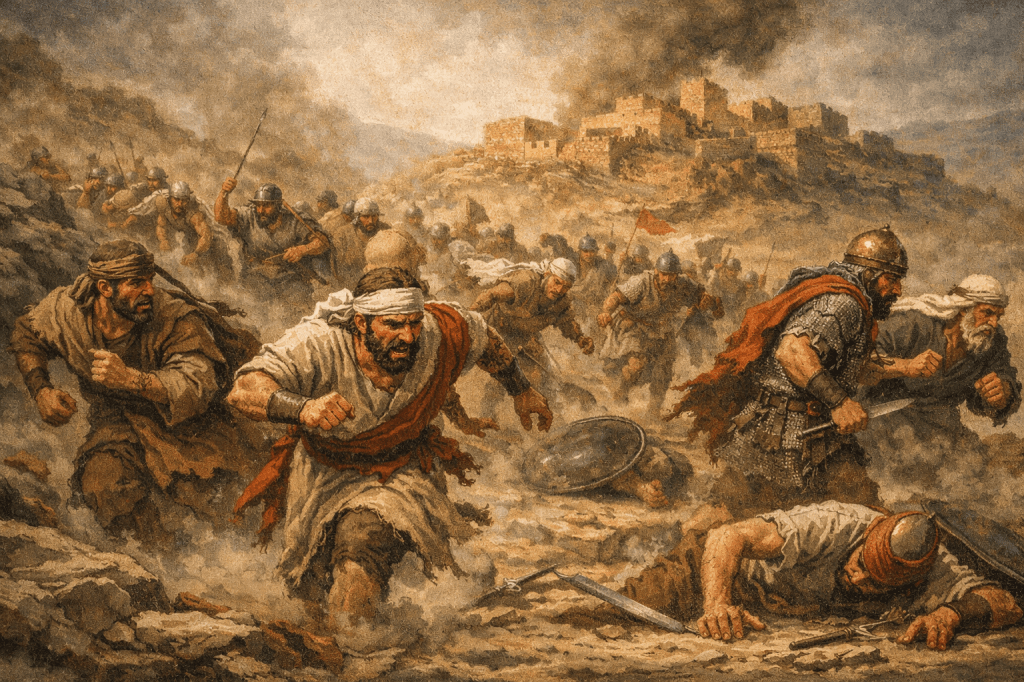
The defeat at Ai is especially shocking because it follows so quickly after Jericho’s miraculous victory. The contrast could not be more dramatic. At Jericho, God had demonstrated His power unmistakably. The people had obeyed His instructions precisely, and the result had been overwhelming success.
Because of that triumph, the next battle seemed almost insignificant. Ai was a small city, and Israel’s spies advised Joshua that only a portion of the army would be needed.
But what appeared to be a minor obstacle turned into a devastating loss. The soldiers fled before the men of Ai, and fear spread through the camp like wildfire. Scripture says that the hearts of the people “melted and became like water” (Joshua 7:5).
In moments like these, even faithful leaders can feel overwhelmed. Joshua’s instinct is to seek God, and rightly so. Yet as the narrative unfolds, it becomes clear that something deeper lies beneath Israel’s defeat.
Prayer is a key in the arms of faith, but the situation at hand demands something, and we will cover that next.
When prayer becomes paralysis
Joshua’s response to the crisis is deeply emotional. He falls before the ark of the Lord, mourning the loss and questioning what has happened. His prayer reflects the anxiety of a leader who fears not only military failure but also the dishonour of God’s name among the surrounding nations.
This is echoed in his prayer when he says, “O Lord, what shall I say when Israel turns its back before its enemies?” (Joshua 7:8, NKJV).
In many situations, prayer is exactly what God calls His people to do. But here, something is wrong. Joshua is asking God to explain a problem that God has already addressed.
The Lord had given clear instructions after the fall of Jericho. Certain items in the city were to be destroyed, and no one was to take them for personal use (Joshua 6:18-19). Yet someone in Israel had violated that command.
Joshua does not know this yet. But God does.
And so God interrupts Joshua’s prayer with a command that might seem surprising: “Get up!”
Prayer is not the problem, but in this moment, prayer is not the solution either.
But why does God command Joshua to get up?
“Get up!”
The Lord’s first words to Joshua are not gentle reassurance but firm direction. Instead, it is a command: “Get up! Why do you lie thus on your face?”
God is not rebuking Joshua for seeking Him. Instead, He is redirecting him. The issue before Israel cannot be solved by lament alone. It must be confronted.
God immediately reveals the heart of the matter:
“Israel has sinned, and they have also transgressed My covenant which I commanded them. For they have even taken some of the accursed things, and have both stolen and deceived; and they have also put it among their own stuff” (Joshua 7:11, NKJV).
The defeat at Ai is not a military mystery; it is a spiritual one. Hidden sin has entered the camp, and until it is addressed, Israel cannot expect God’s blessing.
This moment teaches an important lesson: prayer must sometimes lead us to investigate and to obey. Falling before God is right, but eventually we must rise and deal with what He reveals.
There is every reason to fear cherished sins amongst God’s people. We’ll cover that in the next section.
The sin in the camp
The story soon uncovers the source of Israel’s trouble. A man named Achan had secretly taken some of the forbidden items from Jericho. A beautiful garment, silver, and gold. He hid them beneath his tent, believing no one would know.

But God had seen.
Because Israel was a covenant community, Achan’s private act affected the entire nation. The defeat at Ai was not simply the consequence of poor strategy; it was the result of broken obedience.
The LORD makes it plain to Joshua:
“Therefore the children of Israel could not stand before their enemies, but turned their backs before their enemies, because they have become doomed to destruction. Neither will I be with you anymore, unless you destroy the accursed from among you. Get up, sanctify the people, and say, ‘Sanctify yourselves for tomorrow, because thus says the Lord God of Israel: “There is an accursed thing in your midst, O Israel; you cannot stand before your enemies until you take away the accursed thing from among you.”” (Joshua 7:12-13, NKJV).
Ellen White describes the seriousness of this moment:
“Achan’s sin brought disaster upon the whole nation. For one man’s sin the displeasure of God will rest upon His church till the transgression is searched out and put away. The influence most to be feared by the church is not that of open opposers, infidels, and blasphemers, but of inconsistent professors of Christ. These are the ones that keep back the blessing of the God of Israel and bring weakness upon His people.” —Patriarchs and Prophets, p. 497
What had been hidden beneath the ground in Achan’s tent had also become hidden beneath Israel’s apparent success. Jericho’s victory had not removed the need for continued faithfulness.
God’s question to Joshua was therefore not meant to shame him, but to awaken him to the real issue.
Conclusion
God’s question still speaks with surprising relevance: “Why do you lie thus on your face?”
Sometimes our prayers focus on problems that God has already explained. We ask Him to remove difficulties when He is calling us to examine our hearts. We plead for victory while ignoring the compromises that weaken us.
Joshua’s story reminds us that spiritual leadership—and spiritual maturity—requires both humility before God and courage to confront what He reveals.
- Are there moments when we pray instead of obey?
- Are there situations where the real issue lies hidden beneath the surface?
- Are we willing to rise when God says, “Get up”?
The Lord did not leave Israel in defeat. Once the sin in the camp was addressed, His presence returned, and victory followed again.
But the turning point began with a question—one that moved Joshua from despair to action: “Why do you lie thus on your face?”
It is a question that calls every believer to rise, examine the heart, and walk again in the path of obedience. As you pray for God’s intervention, may you search your soul and remove any ‘accursed thing’ that may be hid under your tent.

 The Cleaver
One thought on “Questions God Asks #18: Why Do You Lie Thus on Your Face?”