
Judgment is one of the most misunderstood doctrines in Christianity. Some believe reward is granted immediately at death. Others reduce judgment to a single courtroom event at the end of time. Still others fear judgment as though salvation hangs by a thread of human performance.
Yet Scripture presents a morally coherent, Christ-centred, and multi-phase picture of judgement that harmonises with the resurrection, the state of the dead, and the final eradication of evil.
This article seeks to answer four central questions:
- When does judgment occur?
- How many phases of judgment does Scripture describe?
- What is the purpose of each phase?
- Why should believers rejoice rather than fear?
To answer these questions, we’ll cover:
- Judgement and the problem of immediate reward
- The biblical pattern: Judgement as a process
- The Investigative (pre-advent) Judgement
- The Judgement at Christ’s appearing (reward phase)
- The millennial judgement: Reviewing God’s decisions
- The great white throne: Executive judgment
- Does Investigative Judgement undermine assurance?
- Why believers rejoice in judgment
- Conclusion
Let’s begin by dealing with the concerns around judgment and immediate reward.
Judgement and the problem of immediate reward
Most people believe that death comes with immediate results and the sealing of human fate. A common assumption is that at death, a soul is instantly judged and rewarded with heaven or hell.
However, the Bible consistently ties reward to resurrection, not to death.
Jesus said:

“For the Son of Man will come in the glory of His Father with His angels, and then He will reward each according to his works” (Matthew 16:27, NKJV).
Notice the sequence: Christ comes, then He rewards. Not that humans die and are rewarded according to their works.
Likewise:
“And behold, I am coming quickly, and My reward is with Me, to give to every one according to his work” (Revelation 22:12, NKJV).
If reward is brought at His coming, it is not distributed at death.
Paul confirms this:
“For the Lord Himself will descend from heaven with a shout, with the voice of an archangel, and with the trumpet of God. And the dead in Christ will rise first” (1 Thessalonians 4:16, NKJV).
Immortality is bestowed at resurrection (1 Corinthians 15:51-54), not before.
This harmonises with the doctrine of the state of the dead:
- “The dead know nothing” (Ecclesiastes 9:5).
- David “did not ascend into the heavens” (Acts 2:34).
Therefore, we can confidently conclude that: Death is sleep, resurrection precedes reward, and judgment determines outcome.
Let’s now look at the biblical pattern of the Judgement Process.
The biblical pattern: Judgement as a process
Scripture presents judgment not as a single moment but as a sequence unfolding within salvation history.
We see at least four distinct movements:
- Pre-Advent (Investigative) Judgement
- Reward at the Second Coming
- Millennial Review Judgement
- Executive (Final) Judgement
Let us examine each.
The Investigative (pre-advent) Judgement
The clearest judicial scene in Scripture appears in Daniel 7.
“A fiery stream issued and came forth from before Him. A thousand thousands ministered to Him; ten thousand times ten thousand stood before Him. The court was seated, and the books were opened” (Daniel 7:10, NKJV).
The timing here is critical. The scene occurs after the rise of earthly powers (7:1–8), but before the Son of Man receives the kingdom (7:13–14), and before the saints possess the kingdom (7:22, 27).
This is a heavenly courtroom scene prior to the establishment of Christ’s visible reign. Several features stand out:
A. Books are opened
This indicates review, transparency, and record. The book of Revelation echoes this imagery:
“Books were opened… and the dead were judged according to their works” (Revelation 20:12, NKJV).
Judgement is not arbitrary. It is documented.

B. Judgement in favour of the Saints
While everyone may be scared about the judgment, the saints need not fear:
“until the Ancient of Days came, and a judgment was made in favor of the saints of the Most High, and the time came for the saints to possess the kingdom.” (Daniel 7:22, NKJV).
The verdict is not against believers but for them. If anyone needs to be scared of judgment, it is not anyone who identifies as a believer in Jesus. Do you believe in Jesus? Then why are you afraid?
This phase vindicates the justice of God, the authenticity of saving faith, and the fairness of divine mercy.
C. New Testament parallels
Peter writes:
“For the time has come for judgment to begin at the house of God; and if it begins with us first, what will be the end of those who do not obey the gospel of God?” (1 Peter 4:17, NKJV).
This implies a pre-consummation phase involving God’s people.
Hebrews adds:
“For Christ has not entered the holy places made with hands, which are copies of the true, but into heaven itself, now to appear in the presence of God for us” (Hebrews 9:24, NKJV).
Christ’s priestly ministry includes intercession prior to the final reward. Learn more about why Christ’s Intercessory Ministry is Necessary.
Theological Function of Investigative Judgment
This judgment does not inform God (He is omniscient). It demonstrates His righteousness before the watching universe (Romans 3:4; Ephesians 3:10).
Salvation is by grace, but God publicly reveals that grace is just.
Let’s now explore judgment at the second coming of Christ.
The Judgement at Christ’s appearing (reward phase)
At the Second Coming:
- The righteous dead rise (1 Thessalonians 4:16).
- The living righteous are transformed (1 Corinthians 15:52).
- Each receives according to his works (2 Corinthians 5:10).
This is not investigative. It is declarative and executive for the saved. The verdict has already been determined. The reward is now bestowed.
This safeguards:
- The finality of resurrection.
- The integrity of divine justice.
- The public vindication of the redeemed.
This leads us to the millennium, and with it comes the millennial judgment.
The millennial judgement: Reviewing God’s decisions
Revelation 20:4 declares:
“And I saw thrones, and they sat on them, and judgment was committed to them. Then I saw the souls of those who had been beheaded for their witness to Jesus and for the word of God, who had not worshiped the beast or his image, and had not received his mark on their foreheads or on their hands. And they lived and reigned with Christ for a thousand years” (NKJV).
Paul anticipated this:
“Do you not know that the saints will judge the world? And if the world will be judged by you, are you unworthy to judge the smallest matters? Do you not know that we shall judge angels? How much more, things that pertain to this life?” (1 Corinthians 6:2-3, NKJV).
This phase occurs after the righteous are glorified and before the wicked are destroyed.
Its purpose:
- To review the justice of God’s decisions.
- To answer unresolved moral questions.
- To demonstrate that no one is lost arbitrarily.
The millennium is not about uncertainty. Instead, it is about transparency. God’s government is examined and affirmed. God is not afraid of scrutiny.
And after this comes the great white throne judgment. Let’s see how the bible talks about.
The great white throne: Executive judgment
After the millennium:
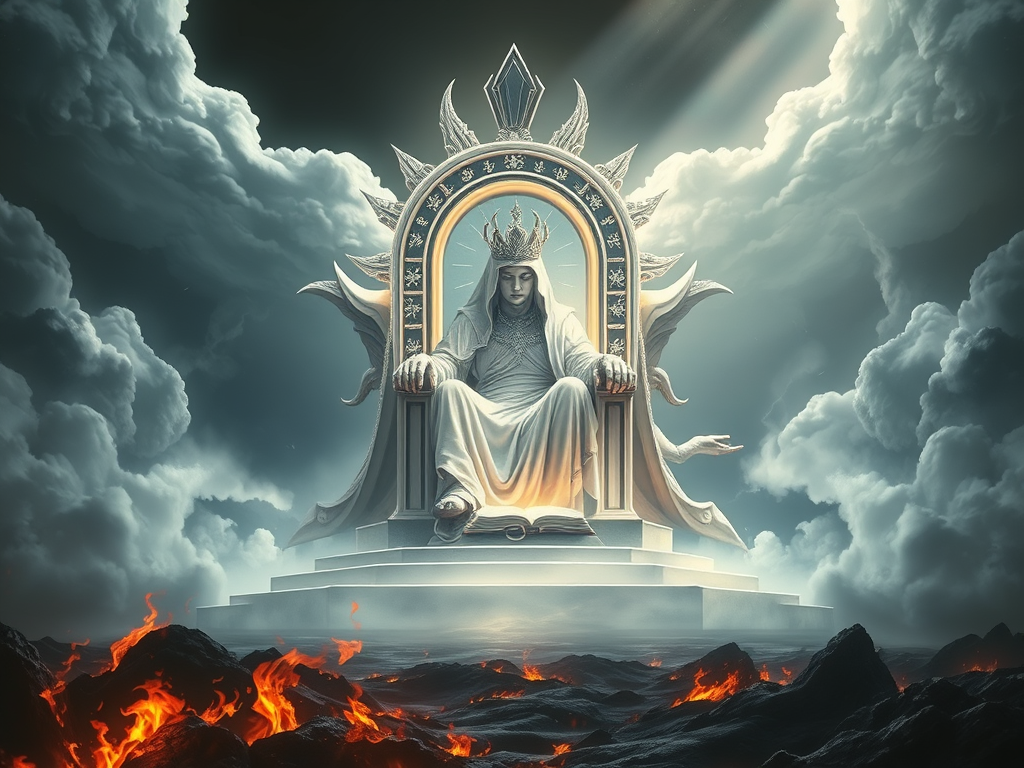
“Then I saw a great white throne and Him who sat on it, from whose face the earth and the heaven fled away. And there was found no place for them… And anyone not found written in the Book of Life was cast into the lake of fire” (Revelation 20:11,15, NKJV).
This is the final sentencing and destruction.
It corresponds with other texts, such as “The day which is coming shall burn them up” (Malachi 4:1), and that “The wages of sin is death” (Romans 6:23).
This is not eternal conscious torment. It is the final eradication of evil. Death and Hades themselves are destroyed (Revelation 20:14). Sin does not smoulder forever.
It is eliminated.
Yet some people argue that investigative judgment undermines assurance of salvation. Let’s deal with that next.
Does Investigative Judgement undermine assurance?
This is the most serious concern.
Some argue that “If believers are investigated, assurance disappears.” Yet Scripture balances judgment and confidence:
“There is therefore now no condemnation to those who are in Christ Jesus, who do not walk according to the flesh, but according to the Spirit” (Romans 8:1, NKJV).
And even Christ repeated this in the gospels:
“Most assuredly, I say to you, he who hears My word and believes in Him who sent Me has everlasting life, and shall not come into judgment, but has passed from death into life” (John 5:24, NKJV).
How do we reconcile this?
The key distinction:
- Judgment determines who is in Christ.
- It does not re-evaluate Christ’s sufficiency.
While justification is complete, judgment reveals who has truly received it. Works are evidence, not merit (James 2:26). The believer does not fear exposure because Christ is Advocate (1 John 2:1).
So, true believers in the complete works of Christ need to rejoice that God will judge and reward everyone as they deserve. Let’s find out why.
Why believers rejoice in judgment
For the lost, judgment exposes rebellionBut for the saved, judgment confirms redemption. Daniel says judgment is rendered “in favour of the saints” (Daniel 7:22).
So, judgment is not the enemy of grace but a public vindication of grace. The final word over the believer is not “condemned.” Instead, it is “vindicated in Christ.”

To the rejectors of grace and the disobedient, it is a countdown to catastrophe, but to the saints, it is the blessed hope and day of recompense.
Therefore, we echo “He who testifies to these things says, ‘Surely I am coming quickly.’ Amen. Even so, come, Lord Jesus!” (Revelation 22:20, NKJV).
Conclusion
Judgement is not a single fearful event. It is the unfolding demonstration that:
- God is just.
- Christ’s sacrifice is sufficient.
- Salvation is fair.
- Evil will end.
- The redeemed are secure.
Far from undermining hope, the biblical doctrine of judgment completes it. The cross secured our salvation.
The judgment reveals its justice.
The resurrection realizes its promise.
The kingdom secures it forever.

 The Cleaver
My name is Alan Finch. I became a Christian in April of 1976. The Great White Throne Judgment has been greatly misunderstood by many.
The Great White Throne Judgment is not going to be for the purpose of casting people into a physical Lake of Fire but will be for the purpose of reconciling to God all those who come before the Great White Throne Judgment.
The Lake of Fire is actually a metaphor for God’s lake of reconciling all those who come before Him at the Great White Throne Judgment.
I spent several years preparing a document titled “What is the GOOD NEWS of the Gospel of Jesus Christ.” If anyone is interested in reading my document, email me:
candy33alan@aol.com, and I will email you a copy.
LikeLiked by 1 person
Alan, thank you for sharing your perspective and for your evident desire to uphold the goodness of the gospel and God’s reconciling heart. That emphasis on God’s grace is something Scripture clearly affirms (2 Corinthians 5:18–19, NKJV).
At the same time, the Bible presents the Great White Throne Judgment in Revelation 20:11–15 (NKJV) as a decisive and final judgment. The passage states that those not found in the Book of Life are “cast into the lake of fire,” which is called “the second death.” In its immediate context, this language points not to restoration, but to a final outcome following judgment.
While Scripture does use symbolic imagery—especially in Revelation—the meaning of those symbols is still governed by context. Here, the “lake of fire” is explained within the passage itself as the “second death,” suggesting finality rather than a process of reconciliation. This aligns with other passages such as Matthew 25:46 (NKJV), which presents a clear distinction between “eternal life” and “everlasting punishment.”
The good news of the gospel is indeed about reconciliation—but Scripture consistently places that opportunity before the final judgment (2 Corinthians 6:2, NKJV). God’s desire is that all should be saved, yet He does not override human response.
So while your emphasis on God’s mercy is deeply valued, the broader witness of Scripture holds mercy and justice together, urging us to respond to Christ now, while that invitation remains open.
LikeLiked by 1 person