
“Then the Lord said to Moses: ‘How long will these people reject Me? And how long will they not believe Me, with all the signs which I have performed among them?’” (Numbers 14:11, NKJV)
Context
The Israelites had come a long way since their deliverance from Egypt. Through mighty signs and wonders, God had revealed Himself as their Deliverer—breaking Pharaoh’s power, parting the Red Sea, and feeding His people daily with bread from heaven. Each miracle testified that the Lord was not a distant deity but a present and personal Savior, guiding them toward the Promised Land.
Now, they stood at Kadesh-Barnea, the border of Canaan. It was the moment they had long anticipated, the threshold of fulfillment. Twelve spies had gone ahead to survey the land, and their report was a mixture of truth and fear.
The land was indeed fruitful, “flowing with milk and honey,” but the people there were strong and their cities fortified. Ten spies trembled before the challenge. Two—Joshua and Caleb—clung to faith.
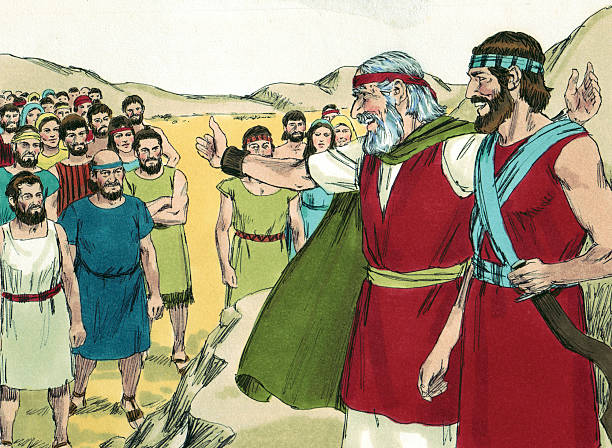
Instead of trusting God’s promise, the people broke into despair. They wept, murmured, and even spoke of returning to Egypt. It was a tragic reversal, the freed slaves longing again for bondage.
Then came God’s question, heavy with pain and tenderness:
“How long will they not believe Me?”
This was not a question of curiosity, but of sorrow. It was the heart of a Father grieved by the distrust of His children; a God who had done everything to prove His faithfulness, yet was still doubted.
We didn’t expect things to go in this direction, given the similar episode when they disobeyed the instructions around Manna.
Hitherto, God had proved Himself truthful, dependable, and consistent. Let’s see how.
The God Who Had Proven Himself
Before this moment, God had already written a testimony of faithfulness in Israel’s history.
- When they faced the Red Sea, He parted the waters.
- When they thirsted, He made bitter waters sweet.
- When they hungered, He sent manna from heaven.
- When they faced enemies, He fought for them.
Each act of deliverance was an invitation to deeper trust—a reminder that their journey depended not on their strength, but on His sufficiency.
Yet, as often happens, memory faded when fear appeared. The people saw giants instead of God. They measured the walls of Jericho but forgot the walls of the Red Sea.
This is the tragedy of unbelief: it erases the past faithfulness of God and magnifies the present fear.
“In their unbelief they limited the power of God and distrusted the hand that had hitherto safely guided them. And they repeated their former error of murmuring against Moses and Aaron. “This, then, is the end of our high hopes,” they said. “This is the land we have traveled all the way from Egypt to possess.” They accused their leaders of deceiving the people and bringing trouble upon Israel.”
—Patriarchs and Prophets, p. 388
God’s question, therefore, strikes not as an accusation, but as heartbreak: “After all you’ve seen, will you still not believe Me?”
Better not know God than to know Him and refuse revealed evidence of his dependability. How dangerous is unbelief?
The Tragedy of Unbelief
Unbelief is more than doubt—it is distrust in the face of revelation. Israel had evidence upon evidence of divine care, yet they allowed fear to outweigh faith.
The ten spies’ report was factually correct—the land did have giants—but their interpretation was wrong. Faith sees the same facts differently. Where unbelief sees defeat, faith sees opportunity for God to act.
Caleb and Joshua understood this:
“Only do not rebel against the Lord, nor fear the people of the land, for they are our bread; their protection has departed from them, and the Lord is with us. Do not fear them” (Numbers 14:9, NKJV).
But the people refused to listen. Their focus on human limitation drowned out divine assurance.

Transitioning from this moment of rebellion, the narrative moves into something even deeper—not just human failure, but divine feeling. Yes, even an Almighty God feels the pain of disappointment.
The Patience and Pain of God
God’s next words to Moses unveil the divine heart: “How long will they not believe Me?” (Numbers 14:11). It is the same cry heard in Exodus 16:28, “How long do you refuse to keep My commandments?”
The repetition is not anger, but grief.
God’s patience is astounding. Every complaint, every doubt, every act of rebellion had been met with mercy. Still, His people refused to trust Him.
Between judgment and mercy, God’s heart trembles. He longs to bless, yet unbelief shuts the door.
Tweet
This moment shows us something profound about God: He is not indifferent to disbelief. He feels it. It wounds love, not pride. His question, “How long?” is the cry of a God who desires to be trusted more than to be obeyed out of fear.
From this divine sorrow, the narrative turns again to the quiet figure of Moses, interceding.
Faith That Takes God at His Word
While the nation trembled, Moses stood in the breach. His intercession was not built on Israel’s worthiness, but on God’s mercy:
“‘The Lord is longsuffering and abundant in mercy, forgiving iniquity and transgression; but He by no means clears the guilty, visiting the iniquity of the fathers on the children to the third and fourth generation” (Numbers 14:18, NKJV)
Moses’ prayer reminds us that faith begins not with our promises to God, but with remembering His promises to us.
Ellen White once wrote:
“Faith is the living power that presses through every barrier, overrides all obstacles, and plants its banner in the heart of the enemy’s camp.”
—Testimonies to the Church, Vol. 4, p. 163
That’s the faith Joshua and Caleb carried into the moment of crisis. They saw the same giants, but they also saw the same God. Theirs was a faith that acts—not blind, not reckless, but rooted in memory.
Their story naturally bridges to ours. Like Israel, we often stand between what God has promised and what fear suggests is possible. The call remains the same: Trust the One who has already proven Himself faithful.
Conclusion
God’s question to Israel still reaches into every age:
“How long will they not believe Me?”
We, too, have seen His hand: In answered prayers, in deliverance, in quiet providences we cannot explain. And yet when uncertainty rises, fear whispers again: “Can God really do this?”
So God’s question becomes personal:
- How long will we hesitate to trust Him fully?
- How long will we let fear rewrite His faithfulness?
- How long will we stand on the edge of promise, unwilling to step forward?
This is not a condemnation. It is an invitation—a call to remember that faith is not the absence of fear, but the refusal to let fear have the final word.
The God who led Israel through the wilderness still leads today. His question waits for an answer in every heart that hesitates between faith and fear: “Will you believe Me now?”
What more should God do for you to believe Him and trust Him?
“In reviewing our past history, having traveled over every step of advance to our present standing, I can say, Praise God! As I see what God has wrought, I am filled with astonishment, and with confidence in Christ as leader. We have nothing to fear for the future, except as we shall forget the way the Lord has led us, and His teaching in our past history.” —God’s Remnant Church, p. 18

 The Cleaver